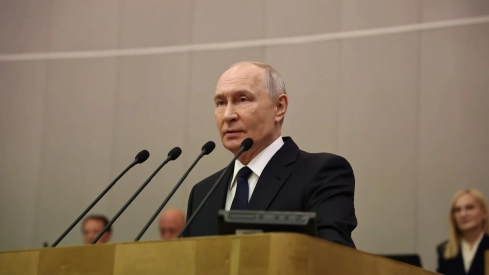
The president of Russia, Vladimir Putin, has once again resorted this Thursday to the threat of using his entire arsenal in the face of an attack against Russian territory, while warning of the risk of a nuclear escalation. "The point of no return can arrive very quickly and unexpectedly for everyone," he declared at the Valdai discussion forum, held near Moscow. His words come a day after the North Atlantic Treaty Organization (NATO) confirmed a Russian diplomatic warning about Kaliningrad.
"We must avoid catastrophic scenarios, in which humanity finds itself on the brink of extinction," he added. Putin combined that appeal with the possibility of resorting to "all available weapons" if there is aggression against Kaliningrad or another Russian region. "This is inevitable," he insisted, although he clarified that Moscow would decide what weaponry to use and that the response would not necessarily have to be nuclear.
The president defended that his diplomats' warnings are "a response" to alleged Western attempts to intimidate Russia. Among them, he included military maneuvers in the Baltic and European statements about preparing for a possible war by the end of this decade. NATO rejects that its exercises threaten Russian territory and has condemned the Kremlin's message.
Kaliningrad, at the center of the threat
Kaliningrad is a Russian territory separated from the rest of the country, located between Poland and Lithuania, both NATO members, and with access to the Baltic Sea. Its position makes it a strategic point for Moscow and a focus of tension with the allies. The Kremlin presents its defense as justification for warning of a response that could widely exceed the scope of a regional incident.
NATO confirmed this Wednesday that it had received a Russian communication about that territory. The Russian embassy in Ireland also warned yesterday that Moscow would be willing to use "its entire arsenal, including nuclear weapons" if the allies tried to isolate Kaliningrad. Putin today backed the diplomatic warnings, although he maintained that the letter did not expressly mention nuclear weapons.
Kremlin advisor Nikolai Patrushev added that Putin has given orders to ensure the security of Kaliningrad, according to the Russian agency TASS. He did not detail the measures. "If they undertake any kind of aggressive action, they will regret it," he declared during a meeting with the region's governor.
In contrast to that version, NATO spokeswoman Allison Hart reiterated that the Alliance is defensive and that none of its activities or exercises represent a risk to Russia. The European Commission on Thursday condemned the nuclear rhetoric and supported the allied response. "The European Union will not give in to Russian threats or contribute to amplifying Moscow's intimidation tactics," said its foreign affairs spokesman, Christian Wigand.
Ukraine remains behind the standoff
The warning about the Baltic comes as Russia maintains its invasion of Ukraine. NATO Secretary General Mark Rutte stated yesterday that Moscow is trying to divide allies and divert their attention from supporting Kyiv through these communications and its destabilizing activities. He also stated that there is no imminent threat to allied territory, while defending maintaining military readiness and aid to Ukraine.
Putin has acknowledged that NATO has superior economic and demographic potential to Russia and has claimed Moscow's weapons as an advantage against that difference. Furthermore, he has assured that 98% of its nuclear weaponry is modernized, a figure presented by the president himself. The reference to the arsenal places the risk of escalation at the center of the debate on European security and military support for Kyiv.
During his speech, the Russian president again justified the invasion and presented parts of Ukraine as "historical Russian territory". "It was not Russia who started the war," he stated, despite Moscow launching the full-scale invasion on February 24, 2022. He also maintained that his forces do not attack targets unrelated to military infrastructure, a version that contrasts with the bombings of Ukrainian cities and civilian facilities.
The president anticipated that international conflicts will probably continue in 2027, without announcing a timetable for ending the war. Meanwhile, he acknowledged the cost of Ukrainian attacks against Russian refineries. According to his own estimate, they have caused losses equivalent to 1% of Russia's gross domestic product.
