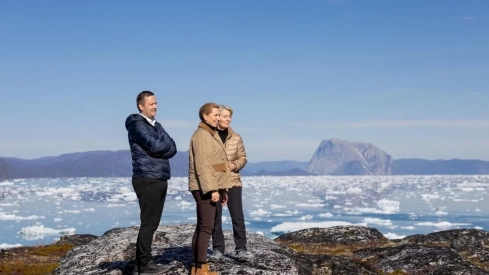
The European Union has decided to strengthen its presence in the Arctic amid a dispute over control of one of the planet's most strategically important regions. The European Commission presented this Tuesday a new strategy to increase security, boost trade connections, and protect critical infrastructure against the advance of Russia and China and the ambitions of US President, Donald Trump, over Greenland. The plan comes after months of tension over Trump's intentions to acquire Greenland, an autonomous territory belonging to the Kingdom of Denmark. The US president has argued that the island is fundamental for the national security of the United States against Moscow and Beijing, but his attempts to increase US control over it have caused concern among European partners and among Greenlandic and Danish authorities.
Brussels' response now involves increasing its strategic autonomy and preventing major powers from deciding the future of the region without Europe. The President of the European Commission, Ursula von der Leyen, has warned that the Arctic has become a flashpoint for geopolitical interests and has defended the need to act in the face of deteriorating international security. "When we see that sovereignty, territorial integrity, and the norms that have guaranteed stability in the region can no longer be taken for granted, we must act and change our strategic posture," she stated.
The EU has also reiterated its support for Denmark and the Greenlandic population against Washington's claims. In a joint statement, the President of the European Council, António Costa, and Von der Leyen defended that "Greenland belongs to its people" and recalled that "it is solely up to Denmark and Greenland to decide on matters affecting them." Both insisted that sovereignty and territorial integrity are fundamental principles of international law.
Trump puts Greenland at the center of the Arctic dispute
Trump's interest in Greenland has raised tensions between the United States and its European allies. The US president has repeatedly defended the need to control the island due to its strategic position and natural resources, and even raised the possibility of using military force to seize it. These threats generated a strong reaction in Europe, which asserted Danish sovereignty and the right of Greenlanders to decide their future. The new European strategy seeks to prevent Washington, Moscow, or Beijing from consolidating a dominant position in a region increasingly important for global security and economy. To this end, Brussels proposes strengthening cooperation with countries such as Norway, Canada, and the United Kingdom, in addition to improving maritime surveillance and European capacity to operate in extreme conditions.
The melting caused by climate change is opening new maritime routes and facilitating access to natural resources, including critical minerals. This has increased the interest of major powers in the territory. Russia has a significant military presence and a large fleet of icebreakers, while China seeks to expand its commercial activity in the region and develop its so-called "polar silk road." Both countries have also conducted joint patrols in the Arctic.
Against this competition, the EU wants to increase its capacity for action without abandoning its climate commitments. The European strategy maintains the objective that oil, coal, and gas remain underground in the Arctic regions, in contrast to Trump's intentions to promote new fossil fuel explorations. Brussels is committed to combining security with environmental protection and sustainable development.
More military surveillance, protection of submarine cables, and new trade routes
Among the main measures announced is the creation of a maritime security center that will allow information sharing and monitoring of possible threats against critical infrastructure. The initiative includes a specific center to supervise and protect submarine cables in the Arctic and North Atlantic, in addition to contributing to their repair if they suffer damage.
These cables are essential for international communications and have become an especially sensitive target given suspicions of sabotage and other hybrid threats. The EU also plans to expand surveillance using satellites and sensors, improve the tracking of vessels in the so-called ghost fleet, and strengthen the detection of illegal activities at sea. The European Commission also wants to expand Europe's icebreaker capacity, improve connections between ports and transport networks, and study new infrastructures that facilitate trade between Greenland, Canada, and the European continent. The goal is for Europe to be able to protect its interests and keep its connections open in a region where the military and economic presence of major powers continues to grow.
The strategy also contemplates boosting scientific research and strengthening cooperation with the communities living in the Arctic. More than half a million EU citizens reside in Arctic territories of Denmark, Finland, and Sweden, which is why Brussels argues that the evolution of the region directly affects European security, climate, and prosperity. With this new plan, the European Union is trying to gain influence in a dispute that is no longer limited to the exploitation of natural resources. The Arctic has become a key scenario for the rivalry between the United States, Russia, and China, and Trump's pressures on Greenland have accelerated European efforts to protect its sovereignty, its infrastructure, and its decision-making capacity.
