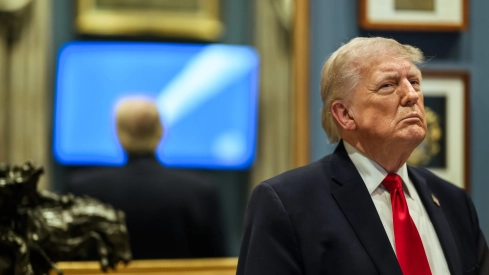
The midterm elections on November 3 are shaping up to be a decisive test for Donald Trump. Two years after his return to the White House, the US president faces elections that could strip Republicans of control of Congress and limit his ability to push through his agenda during the second half of his term. Polls paint a favorable scenario for the Democratic opposition, driven by discontent with economic management and the decline in presidential popularity.
The battle is not limited to a dispute between two parties: it also measures to what extent Trump's leadership continues to mobilize his voters and how much the wear and tear of his government weighs among those who gave him victory in 2024. In this context, Elon Musk's extraordinary investment in Republican campaigns contrasts with the party's electoral difficulties and with doubts about its ability to retain parliamentary majorities.
Polls give Democrats an advantage, but the electoral battle will be more complicated than it seems
The average of polls collected by RealClearPolitics places Democrats ahead in voting intention for the House of Representatives, with 50.2%, compared to 41.9% for Republicans. The opposition needs to win at least three net seats to gain control of the Lower House, where Republicans currently hold a narrow majority of 219 representatives against 214 Democrats. The parliamentary margin makes numerous districts decisive that until recently seemed safer for Trump's party.
The Senate presents a more complex scenario. Republicans have 53 seats compared to 47 Democrats, and the opposition needs to snatch four seats from their rivals to reach a majority, provided they retain their own. The dispute is particularly tight in states like Alaska, Iowa, Kansas, Maine, Michigan, Ohio, and Texas. The latter stands out for the advantage that Democrat James Talarico holds over Republican Ken Paxton, an ally of Trump.
Despite the Democratic advantage, the result is not decided. National polls do not always translate into seats, and the electoral map, turnout, and geographical distribution of votes can alter forecasts. Furthermore, Democrats need to convert discontent with the government into effective votes in decisive constituencies. History plays in their favor: recent presidents tend to lose ground in midterm elections, and Trump already experienced this dynamic during his first term.
Trump loses support and Republicans begin to feel the wear and tear of his leadership
Trump's popularity has become one of the main electoral problems for his party. Poll averages cited by EFE place his approval around 38%, while a Pew Research Center survey reflects that only 35% trust him to make good economic decisions. Americans' wallets have thus been placed at the center of the campaign, at a time when the president needs to convince voters that his management is yielding results.
The wear and tear also extends to the image of the Republican Party. A Gallup poll published on October 13 reveals that 51% of Americans trust Democrats more to maintain economic prosperity, compared to 37% who prefer Republicans. This is the first clear advantage for Democrats on this issue since 2012. Furthermore, 59% consider the Republican Party to be too extremist, a figure that points to the party's difficulties in broadening its appeal beyond Trump's loyal base.
The difficulties are also reflected in the electoral strategy. According to Associated Press, Republicans have begun to withdraw resources from some competitive House of Representatives districts to concentrate them in territories where they consider it more urgent to protect their options. Meanwhile, Trump maintains an intense presence in the campaign, with rallies and messages aimed at mobilizing the MAGA movement. The commitment to keeping his base mobilized thus coexists with the challenge of winning back discontented voters and preventing rejection of the president from translating into a parliamentary defeat.
Elon Musk puts 276 million dollars on the table to save Republican majorities
In the midst of electoral uncertainty, Elon Musk has once again demonstrated the weight his fortune can have in US politics. The businessman has donated 276 million dollars since July to groups affiliated with the Republican Party and his own political action committee, America PAC, with the aim of strengthening conservative campaigns in the midterm elections. The figure makes him the main known donor to the Republicans for these elections and exceeds what he contributed during the 2024 presidential campaign.
Most of the money has gone to organizations capable of backing Republican candidates in both chambers. Musk has contributed 158 million dollars to the Senate Leadership Fund, 20 million to the Congressional Leadership Fund, and 76 million to America PAC, in addition to another 10 million to the Lone Star Liberty PAC, which supports Republican Ken Paxton in Texas. In total, his contributions to the electoral cycle that began in January 2025 amount to some 366 million dollars, above the 290 million he disbursed for the 2024 presidential elections.
The magnitude of the investment contrasts with statements made by Musk himself in May 2025, when he assured that he would reduce his political spending. It also reflects the importance that large donors can acquire when control of Congress is decided by a few seats. Although money allows for financing advertising and strengthening campaigns, it does not guarantee a victory: Republicans must face the wear and tear of Trump, economic doubts, and adverse polls. On November 3, it will be seen whether Musk's financial capacity manages to compensate for these difficulties or whether Democrats take advantage of the opportunity to regain legislative power.
