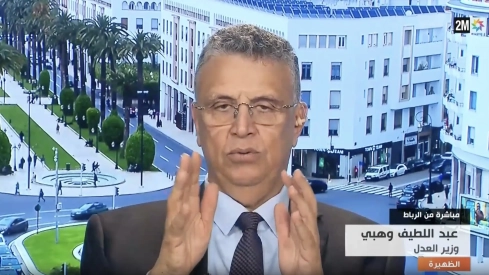
The Moroccan Government has once again challenged Spanish sovereignty over Ceuta and Melilla. Its Minister of Justice, Abdellatif Ouahbi, demanded this Friday the opening of a negotiation with Spain to ensure that the two cities "return to the bosom of the homeland". It is the second offensive launched by the same leader in just ten days and comes while Ceuta is still trying to address the human and social consequences of the massive entry recorded at the end of July.
Ouahbi defended in an interview granted to the Moroccan public channel '2M' that Ceuta and Melilla constitute a supposed "historical and geographical right" of Morocco. The minister asked to create a "dialogue commission" with Madrid and maintained that Rabat must seek a "definitive solution" to take over the two Spanish cities. "One cannot remain silent," he even stated when presenting as a pending issue what Spain considers outside of any discussion.
The member of Aziz Akhannouch's Government also mixed the territorial claim with the file of Moroccan minors who arrived in Ceuta during the border crisis of July 30 and 31. Ouahbi assured that Rabat is willing to receive them after verifying their identities and demanded their return. The interview also takes place just over a month before the Moroccan legislative elections on September 23, in which the Party of Authenticity and Modernity, to which the minister belongs, will participate.
The second offensive in ten days
Ouahbi's words are part of a perfectly recognizable escalation. Last August 11, he already assured in an interview with the Saudi channel 'Asharq News' that Morocco raises the sovereignty of Ceuta and Melilla every time it meets with Spanish representatives. He also spoke of a long-term strategy and of acting "with patience" to achieve its territorial objectives.
The Ministry of Foreign Affairs denied the Moroccan minister the next day. Diplomatic sources stressed that "the Spanishness of Ceuta and Melilla is beyond all doubt" and assured that the territorial integrity of Spain "has neither been discussed nor will ever be discussed with anyone." The Minister of Defense, Margarita Robles, was equally emphatic in stating that both cities are "very Spanish", while Fernando Grande-Marlaska recalled that they are part of Spain with the same fullness as any other territory.
Rabat has maintained this claim since Morocco's independence in 1956. Hassan II proposed in 1987 a bilateral "reflection cell" on the future of Ceuta and Melilla, an initiative that Spain never accepted. Tension reappeared in 2007, when Morocco recalled its ambassador for consultations in response to the visit of Kings Juan Carlos and Sofía to the two autonomous cities.
The diplomatic rapprochement initiated in 2022 also did not modify that position. Spain then backed the Moroccan autonomy plan for Western Sahara as the "most serious, realistic, and credible" basis for resolving that conflict. In return, a new stage of migratory, economic, and security cooperation opened. None of the agreements reached included the sovereignty of Ceuta and Melilla, despite Rabat having continued to use the claim at different moments of tension.
Two Spanish cities outside negotiation
The claim launched by Ouahbi clashes with the political and legal reality of the two cities. Ceuta was definitively linked to the Spanish Crown in the 17th century, and Portugal recognized that sovereignty through the Treaty of Lisbon of 1668. Melilla has been part of the Spanish Crown since 1497. Their respective Statutes of Autonomy, approved in 1995, expressly define them as an integral part of the Spanish nation.
Ceuta and Melilla are also part of the European Union, although they have a specific fiscal and customs regime. The UN also does not include them in its list of territories pending decolonization. Morocco tried to introduce this issue before the Special Committee on Decolonization in 1975, without succeeding in having the cities incorporated into that list. Rabat's successive declarations therefore have no legal effects on Spanish sovereignty.
The Moroccan minister has now incorporated into his offensive the return of minors who arrived during the migratory crisis. Legislation requires studying each case separately, locating families, accrediting a safe reception, and attending to the best interest of the child. The Spanish Government is meanwhile working on the transfer to the Peninsula of 500 particularly vulnerable girls housed in Ceuta.
Foreign Affairs has not announced any commission or negotiation after the new declarations. Ouahbi's proposal lacks Spanish interlocution, and the sovereignty of Ceuta and Melilla remains off the bilateral agenda with Morocco.
