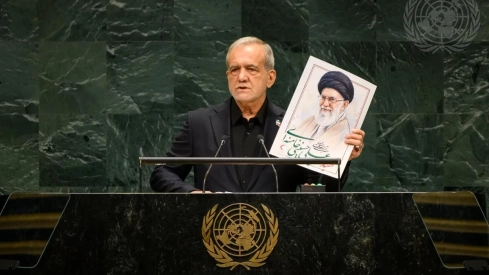
The president of Iran, Masud Pezeshkian, has used the rostrum of the United Nations (UN) General Assembly this Wednesday to respond directly to Donald Trump. One day after the US president threatened to “annihilate” the Islamic Republic if it does not accept an agreement, the Iranian leader has accused the United States and Israel of terrorism and has warned that his country will continue to resist.
“We will never bow our heads or bend our knees,” Pezeshkian proclaimed before world leaders. The only US representative present in the chamber left the room during his speech. Israel’s seats were also empty. The scene completed the exchange of diplomatic gestures initiated on Tuesday, when several members of the Iranian delegation left while Trump defended the offensive against Tehran.
Trump had presented the UN with an extreme dilemma. He offered Iran the possibility of reaching a pact that would allow it to rebuild or face an escalation aimed at rapidly destroying the regime. The threat came from the rostrum of an organization created precisely to prevent conflicts between states from escalating into open wars.
Pezeshkian explained that he had prepared another speech, but decided to modify it after hearing Trump define Iran as a terrorist power. “We have been victims of terrorism,” he replied. The Iranian president defended that his country has only responded to the attacks initiated almost seven months ago by the United States and Israel.
The toughest moment of the intervention occurred when he held up photographs of supreme leader Ali Khamenei, assassinated at the beginning of the war, and of the children killed in the bombing of the Shajareh Tayyebeh school in Minab. More than 150 students and teachers lost their lives in that US attack on February 28.
“These children died under bombs dropped by the United States and Israel. They were innocent, they had committed no crime,” he denounced. An independent United Nations mission has found evidence of war crimes in that bombing, considering that US forces attacked a civilian target without taking the precautions required by international law. The same report also attributes crimes against humanity to the Iranian regime for the repression of internal protests, with executions, torture, arbitrary detentions, and systematic attacks against demonstrators. Pezeshkian has silenced that part of the conclusions and has presented the Islamic Republic solely as a victim of external aggressions.
His assertion that Iran has never started a war also responds to a self-serving interpretation of its regional role. Tehran has maintained for years a wide network of alliances with armed groups such as Hezbollah, Hamas, and the Houthis in Yemen. The latter have attacked Saudi territory and Red Sea maritime traffic with technology and assistance linked to Iran.
The Iranian leader then took the confrontation to the nuclear arena. He defended his country's right to enrich uranium to produce energy, develop medical treatments, and improve agriculture, while denying that Tehran intends to manufacture an atomic bomb. “The nuclear weapon is in Israel, but the inspectors are in Iran. Israel kills, but Iran is subject to sanctions,” he stated. The comparison points to a real imbalance. Israel remains outside the Nuclear Non-Proliferation Treaty and maintains a policy of ambiguity about its arsenal, while Iran is part of the agreement and is subject to inspections. Doubts about undeclared activities, high levels of enrichment, and restrictions imposed for years on international supervisors have, however, fueled distrust towards Tehran.
Pezeshkian also described Gaza as “an open wound on the international conscience” and accused Israel of committing genocide against the Palestinian population. In his opinion, the inability to stop the occupation and protect civilians demonstrates the failure of international security mechanisms.
Negotiations amid threats
The harshness of the public exchange coexists with a negotiation that continues to advance discreetly in New York. Iranian Foreign Minister, Abbas Araqchi, has held indirect contacts for about three hours with Trump's envoys, Steve Witkoff and Jared Kushner, through the mediation of Qatar.
Trump has defined the meeting as “very good” and has highlighted that it represents some movement after months of failed contacts. Tehran has lowered expectations and maintains that the conversations were limited to repeating its conditions. Iran demands an end to the attacks, the lifting of the blockade on its ports, and the release of frozen assets.
U.S. Secretary of State, Marco Rubio, later responded to Pezeshkian's speech by accusing the Islamic Republic of lacking authority to lecture on human rights and respect for the international system. He also confirmed that Washington keeps the communication channel open, although he avoided speaking of a decisive breakthrough.
The Strait of Hormuz occupies a good part of that negotiation. Before the war, about a fifth of the world's traded oil and liquefied natural gas circulated through this passage. Attacks and navigation restrictions have reduced traffic, raised energy prices, and increased pressure on the Gulf countries and on the U.S. economy itself.
Iran has conveyed to mediators that it could facilitate the reopening of the strait in a few days if Washington reduces its military presence and lifts the naval blockade. Pezeshkian has argued before the UN that the maritime route cannot be used to transport weaponry that is later used to attack Iranian territory.
The Iranian president has also called for a security system built by Middle Eastern countries, with less U.S. military presence. Saudi Arabia, Qatar, and the rest of the Gulf monarchies are looking for a formula that protects navigation and reduces tension, although they are wary of granting Tehran the capacity to supervise traffic through Hormuz.
Washington has not yet confirmed a meeting between Trump and Pezeshkian during his stay in New York. Rubio has left open the possibility of continuing to exchange messages, but has marked the real scope of the conversations held so far. “It was positive in that sense, but I don't want to present it as a major breakthrough,” he admitted.
Add ElConstitucional.es as a preferred Google source for free.
Stay informed about all the latest breaking news with the best information. Against disinformation, for democracy and social rights.
