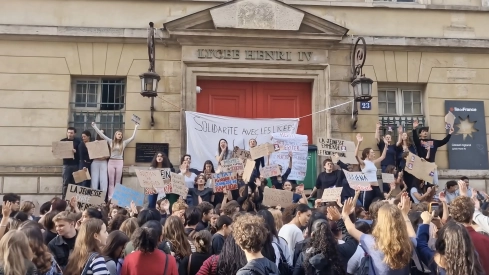
French students will remain in the streets. This Friday's meeting with the Minister of Education, Édouard Geffray, has left youth organizations dissatisfied, and they are maintaining their mobilizations due to the lack of teachers, overcrowded classrooms, and the deterioration of their centers. The next major event will be on Tuesday, October 6, with the support of teaching and workers' unions, after a week of blockades, police charges, and clashes that has forced President Emmanuel Macron's government to try to open a political way out of the crisis.
The discontent is also seen far from the high schools in the most affected peripheries. At Montaigne in Paris, located in the affluent VI district, Justine, Marion, and Lucile have been there since six in the morning to sustain the protest. In 'El País's' report, Justine, 16, explains that there are 35 students per class and that at the beginning of the course there were not enough chairs. She acknowledges that her center has better conditions than others in the periphery, where her friends report leaks, rats, or bedbugs, and she advocates for solidarity with them.
The mobilization has reached Lille, Lyon, Bordeaux, Nantes, Rennes, Strasbourg, and Marseille, and this week it has spread to universities. The blockade also affects emblematic centers such as the Henri-IV high school in Paris, where a video released by 'SHADES' shows students participating in the protest. The lack of resources unites the demands of students from very different centers, even if their starting conditions are far from equal.
🚨 Les LYCÉENS D’HENRI-IV, participent au BLOCUS de leur établissement à Paris, en soutien au mouvement de mobilisation des lycéens et étudiants.
— SHADES (@ShadesFrance) October 1, 2026
🏫 Il s'agit d'un des lycées les plus PRESTIGIEUX et SÉLECTIFS de France, montrant que la mobilisation rassemble des élèves issus de…
The updated Education balance this afternoon places at 735 the establishments that have suffered alterations during Friday, compared to the 564 counted at midday. Geffray has indicated that this is about 30% less than on Thursday, but some 400 high schools, out of approximately 3,700 in the country, have remained closed. Many have tried to move classes online, a formula that unions criticize due to the difficulties of students who lack adequate means.
More teachers and better classrooms
The movement began at the Saint-Exupéry high school in Créteil, on the outskirts of Paris, with protests over staff shortages and operational problems at the center. Calls circulated on networks like TikTok and Snapchat and found similar complaints elsewhere. Students denounce hours without a teacher, excessively long days, deteriorated buildings, and overly numerous groups, while part of the teaching staff has joined demands they have been raising for years.
A 16-year-old student quoted by the BBC from a testimony collected by AFP describes the problem with a phrase that summarizes the scope of the protest. "The educational system is completely collapsed," she states, before explaining that there are 34 students in class and that teachers are overworked. In Strasbourg, Raphael, 17, denounces classrooms with leaks, few bathrooms, and an insufficient cafeteria. "There is no budget, no resources, and not enough supervisors," he laments.
University students add the cost of living, scholarships, and housing aid, in addition to the rejection of academic selection which they consider socially unequal. Among their criticisms appears Parcoursup, the platform that manages access to higher education, while secondary representatives have brought issues such as schedules and mental health to the ministry. The movement thus brings together daily problems of the centers and the fear of young people of not being able to continue their studies.
The discussion comes in the midst of budget negotiations. According to the 2027 draft project reported by Reuters, Education would have 65.530 billion euros, excluding teacher pensions, with an increase of 1.7% lower than inflation. The National Union of Physical Education, part of the Unitary Trade Union Federation, also denounces the forecast to eliminate 1,600 positions for the next academic year. Their reproach to the Executive is that it treats as local incidents shortcomings that it attributes to national decisions.
Geffray announced after the meetings a plan to accelerate teacher substitutions, especially in the last two years of secondary school, and work on school rhythms, although he acknowledged that he would not be able to make a decision on the latter for the start of the 2027 academic year. The Government has also withdrawn the proposal to charge tuition fees to non-scholarship students in certain higher technical education and preparatory classes. Youth organizations believe that concrete commitments are still lacking and maintain pressure.
Police charges and another street protest
The police response and damage to centers have added another front to the crisis. The Minister of Justice, Gérald Darmanin, has placed the number of people arrested since the beginning of the mobilizations at around 2,000 and stated that 90% are minors. Geffray had reported a balance of 170 students and 65 educational workers injured, including 40 high school principals. The Interior Ministry also reported 305 police officers, gendarmes, and firefighters injured on Thursday, according to 'Le Monde'.
Among the most serious incidents is the fire that destroyed the lobby of the Nelson Mandela high school in Nantes on Thursday. This Friday, educational authorities reported that a teacher was doused with gasoline and assaulted in La Ciotat, near Marseille. Student representatives have condemned the attacks against centers and their staff, and reject that those who cause such damage represent their demands.
Francia: los estudiantes bloquean institutos y se enfrentan a las fuerzas policiales en diferentes ciudades de todo el país. Exigen mejoras en las codiciones y más profesores coincidiendo con las manifestaciones sindicales en contra de los recortes en los servicios públicos. pic.twitter.com/tnRjcXCu6D
— Periódico Anarquía (@anarquia_p) September 30, 2026
They also denounce the excessive use of force against young people. Authorities have opened four investigations into possible violent police actions, according to the latest information from Reuters, including one related to a teenager who suffered an eye injury. In Rennes, Lola, 16, has argued that she was demonstrating peacefully and has criticized the officers' response. "The police have no right to hit us or throw tear gas at us," she told AFP.
Darmanin has asked prosecutors to demand that parents pay for the cost of damages caused by their children. "It is not the minors who pay but their parents," he said, presenting the incidents as a public order problem. Geffray has called on families to prevent minors from attending blockades because he considers them to be in danger, although he recognizes the legitimacy of some of their demands. Other parents have accompanied the protests to support their children and protect them.
The confrontation also has a political dimension a few months before the 2027 presidential elections. The government accuses La France Insoumise (LFI), Jean-Luc Mélenchon's party, of encouraging and instrumentalizing the movement, an accusation that the party and student representatives reject. Mélenchon has supported the mobilizations, but has also called for discipline and warned that images of burning containers serve the adversary.
The High School Students' Union (USL, for its acronym in French) maintains the call for Tuesday, along with university organizations. The General Confederation of Labor, Solidaires, and teachers' unions of the Unitary Union Federation will join the day, with calls for strikes among teachers. Sophie Vénétitay, general secretary of the main high school teachers' union, has called for a response that goes beyond each school. "We cannot get out of this crisis without a national political response."
