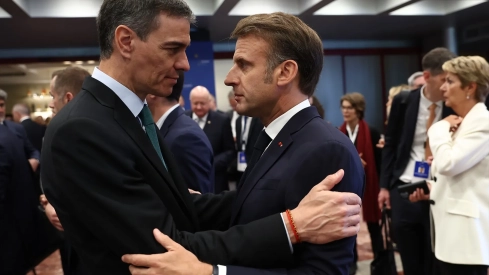
France has clearly distanced itself from the open offensive against Spain over the Ceuta migration crisis. The Government of Emmanuel Macron has refused to sign the letter promoted by Italy and supported by 21 other European Union countries, considering that the document seeks to undermine the Executive of Pedro Sánchez instead of offering a useful response to what happened.
Sources from the French Embassy in Madrid explained this Monday that the letter lacked "concrete solidarity" and its main objective was "to instrumentalize the migratory wave in Ceuta against the Spanish Government". Paris understands that the solution must be based on cooperation with Spain and Morocco, control of the external border, and European aid when necessary.
The French position contrasts with the tone adopted by the bloc led by Giorgia Meloni. The letter links the massive entry with the recent Supreme Court ruling on hot returns and proposes reinforcing or recovering temporary controls at internal borders to prevent possible displacements to other States.
This risk has not occurred during the Ceuta crisis. None of the people who crossed irregularly have traveled to the Peninsula or reached another EU country. The letter itself acknowledges that no secondary movements have been detected so far, although it uses this possibility to justify a tightening of controls.
France has also recalled that Ceuta has a specific regime within the Schengen area. Controls for traveling from the autonomous city to the Peninsula and the rest of Europe are systematic, so irregular entry from Morocco does not allow free movement through EU countries.
The French Embassy considers that the reaction promoted from Rome was "out of place" given the speed of the returns. Paris has used the balance of 48,300 people who returned to Morocco during the first 24 hours, about 96% of those initially counted by the Government, to defend Spain's capacity to apply returns within the European framework.
The figures have continued to change since then. The latest government estimate places the number of irregular migrants remaining in Ceuta at around 2,500, while Juan Jesús Vivas's Executive raises the estimate to a range of between 3,000 and 5,000. The city also keeps 862 minors who arrived during the crisis under its guardianship.
Macron offers help and rejects breaking Schengen
Emmanuel Macron made his position public last Friday after speaking with Pedro Sánchez. The French president conveyed his solidarity to Spain and offered "all necessary help," both bilaterally and through the intervention of Frontex, the European Border and Coast Guard Agency.
Face à la situation migratoire à Ceuta, j’ai été en contact avec le Président du gouvernement espagnol pour marquer notre solidarité et proposer toute aide nécessaire, y compris via Frontex.
— Emmanuel Macron (@EmmanuelMacron) July 31, 2026
Je salue la coopération en cours avec le Maroc,…
Macron also valued the cooperation that Spain and Morocco had launched to facilitate returns. The Interior Ministers of both countries have since maintained close contact to monitor the evolution of the border and prepare the response to any new entry attempt.
Spain has not yet requested direct intervention from Frontex in Ceuta. The French offer remains available while the deployment of Spanish and Moroccan forces continues on both sides of Tarajal.
Paris has simultaneously reinforced surveillance at the Franco-Spanish border with four mobile force units, planes, and drones. The measure seeks to prevent eventual irregular movements towards France, although Macron's Executive has separated this preventive measure from the general questioning of free movement promoted by Italy.
The French Interior Minister, Laurent Nuñez, has assured that there is "absolutely" no reason to suspend Schengen with Spain. He also described the cooperation between the two countries as "very, very good" and explained that Spain readmits approximately 70% of irregular migrants intercepted by France near the border.
The French response thus combines the reinforcement of its own controls with political support for Spain. Faced with threats to suspend free movement and accusations against Spanish migration policy, Paris has offered concrete means, police cooperation, and European support without conveying an alarm that the movements registered from Ceuta do not justify.
France has also recalled the solidarity provided by Spain and by the Union as a whole during the crises experienced on the border between Poland and Belarus in 2021 and in Lampedusa in 2023. In the opinion of the Macron Executive, the letter promoted by Italy forgets those precedents and deviates from the balance between responsibility and solidarity on which the new European Pact on Migration and Asylum was built.
The Interior Ministers of the European Union will meet this Tuesday by videoconference to address what happened in Ceuta. Cooperation with Morocco, possible support from Frontex, and a common response to future border crises will be the focus of a meeting that France will attend defending its support for Spain.
Add ElConstitucional.es as a preferred Google source for free.
Stay informed about all the latest breaking news with the best information. Against disinformation, for democracy and social rights.
