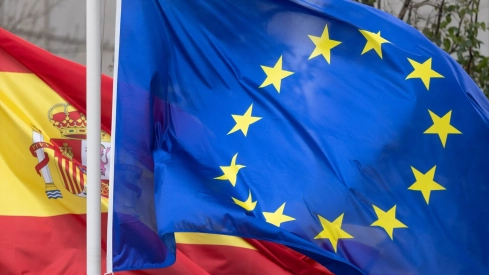
The European defense stumbles again on its old problem: any member state can block a common decision. In the midst of pressure from the United States for Europe to assume more military burden and at the gates of the NATO summit in Ankara, a report by the Fundación Alternativas proposes opening an uncomfortable debate for Brussels: changing unanimity in security and defense policy.
The proposal appears in the document ‘A More Autonomous Europe. How to reduce our military and technological dependence?’, prepared by consultant Carlos Martí Sempere. The diagnosis is clear. European strategic autonomy remains more an aspiration than a reality as long as the Twenty-Seven have to agree on every sensitive decision.
The current system requires seeking unanimity in most decisions of the Common Security and Defense Policy. In practice, each head of State or Government has a veto. The report points to Hungary as the most evident case due to its blockades or downgrades of common positions related to Russia. When cohesion is lacking, the EU moves late or settles for minimal declarations.
Two ways to break the deadlock
The first option Martí proposes is to introduce a selective majority vote for some security and defense decisions. It would not affect the entire system at once, but it would allow progress on specific positions, initiatives, or declarations without being trapped by a single government.
The advantage would be agility. The political problem is also evident. Small countries fear losing weight against Germany, France, Italy, Spain, or Poland. Large ones, in turn, would have to accept more responsibility, more spending, and more commitment to common capabilities.
The second formula would be more ambitious. The report proposes creating a kind of European Security Council, with Germany, France, Italy, Spain, and Poland as permanent members, along with the President of the European Council and six other rotating countries. This body would assume the center of gravity of common foreign and security policy.
For Spain, this option would have a direct interpretation. The country would gain a fixed seat in the hard core of European defense, but it would also have to sustain it with investment, industry, military capabilities, and a more shared external representation.
NATO accelerates the debate
This week's NATO summit does not formally address this European institutional reform, but the context pushes it. Allies meet in Ankara with Donald Trump pressuring Europe to increase spending, take more responsibility for its own defense, and boost military industrial production.
The Alliance will discuss compliance with new spending targets, support for Ukraine, and strengthening the defense industry. The international agency 'Reuters' anticipates that allies will reaffirm their commitment to collective defense and will also address tension with Iran and security in the Strait of Hormuz. All of this directly affects Europe, although many of the response tools remain in the hands of the States.
That's where the rift appears. The EU wants to talk about strategic autonomy, joint purchases, defense industry, and less technological dependence on the US or China. But in foreign and military policy, it continues to operate with a rule that allows a single partner to stop the whole.
A difficult change with no timetable
The proposal is not a formal initiative of the Commission or the Council. It is a political and academic discussion report, although it comes at a time when several European governments have long been advocating for more qualified majority in foreign policy.
Changing the unanimity rule in defense would be politically very complicated. It would also require touching delicate balances between large and small states, between more ambitious pro-Europeans and countries that still see NATO as the only real umbrella.
The debate is already on the table. The war in Ukraine, Trump's return, pressure on military spending, and tensions in the Middle East have turned European strategic autonomy into more than just a slogan from Brussels.
