Donald Trump has once again made his 2020 electoral defeat the center of American politics. The President of the United States has accused China of intervening for years in the country's elections and has presented the declassification of several Intelligence documents as the great proof of a conspiracy that, six years later, he has still not managed to demonstrate.
The ultra leader used for this purpose a televised speech from the White House, a format normally reserved for national crises or decisions of special transcendence. Trump spoke for about half an hour about the elections he lost to Joe Biden and dedicated barely a few minutes to issues that currently concern Americans more, such as the cost of living, the economic situation, or the war with Iran.
His intervention comes less than four months before the legislative elections on November 3, known as the 'midterms'. Republicans are playing for their narrow majorities in Congress and face a campaign marked by Trump's desgaste, the rise in prices, and the discontent of part of the independent electorate.
The accusation against Beijing also allows him to recover familiar ground. Trump never acknowledged his 2020 defeat, maintained for weeks that there had been massive fraud, and promoted a campaign to reverse the results that led to the assault on the Capitol on January 6, 2021. More than sixty lawsuits, several recounts, and the verifications of his own Department of Justice were unable to find irregularities capable of changing the result.
The documents do not prove that China changed the result
Trump claimed that China illicitly obtained the records of some 220 million American voters, including names, addresses, phone numbers, and political preferences. According to his account, Beijing would have acquired, stolen, or hacked information from 18 states and created a specialized unit to exploit that data.
The collection of electoral information by a foreign power represents a security problem that US authorities have been studying for years. The documents released by the White House also include vulnerabilities in databases, official pages, and systems used during electoral processes. From this, it does not follow that China modified ballots, recounts, or results in the 2020 presidential elections.
The assessment published in 2021 by the Office of the Director of National Intelligence reached precisely that conclusion. Its analysts determined with a high level of confidence that Beijing considered the possibility of influencing the campaign but avoided deploying an operation aimed at changing the winner. Nor did they find Chinese attempts to enter vote-counting systems, alter votes, or finance candidates.
Within the intelligence services, there was a minority opinion. One of its officials considered that China had indeed used official messages, public media, and social networks to indirectly harm Trump's chances. This discrepancy referred to a political influence campaign and also did not point to manipulation of the electoral infrastructure.
The new papers provide information on the search and accumulation of voter data, a common practice among powers interested in understanding the internal politics of their rivals. Trump has combined these reports with different investigations into suspicious registrations in Michigan, electronic machines, and the presence of non-citizens on voter rolls to construct a single narrative of widespread fraud.
The Michigan case refers to irregular registration forms detected by an election official and subsequently transferred to the Police and the FBI. The suspicious applications were set aside before generating valid registrations or votes, although Trump presented them as an operation hidden by the so-called "deep state."
Trump points to his own intelligence agencies
The president also accused members of the FBI, the CIA, and other agencies of hiding information from him during his first term. According to Trump, "deep state" officials downplayed China's activities and prevented both him and Congress from knowing their true extent.
"They wanted to make it look like your president was no big deal," he stated during his speech, before asserting that Beijing tried to mobilize companies, journalists, and leaders opposed to his re-election. Trump even said that China paid large sums of money to American journalists to publish negative articles about him, although he did not show concrete evidence to support that accusation.
He also ordered FBI Director Kash Patel to review the documents and collaborate with the Department of Justice to pursue any possible crimes. Federal agencies must also inform states whose electoral records may have been exposed.
The White House has published the files within a new section dedicated to "election integrity". Along with the documentation, political texts drafted by the Administration itself appear, speaking of hidden fraud, manipulable machines, and hundreds of thousands of foreigners registered to vote. These conclusions go beyond the content accredited by several of the original reports.
Major US networks received the speech with caution. ABC, NBC, and CNN decided not to broadcast it live in its entirety due to the risk of re-disseminating discredited claims about 2020. Trump reacted by also accusing the media of being part of the conspiracy and even suggested revoking their licenses.
China accuses Trump of using it for his campaign
Beijing's response came a few hours later. The spokesperson for the Ministry of Foreign Affairs, Lin Jian, described the accusations as "an invention" and "malicious defamation" which, in his opinion, had already been disproven years ago.
"China has no interest and has never interfered in US elections," Lin said during his daily press conference. The spokesperson asked Washington to stop using the Asian country as an electoral argument and work to maintain the stability of relations between the two powers.
Beijing took advantage of the response to return the accusations. Lin maintained that the international community knows which country has habitually intervened in other countries' internal affairs, monitored governments and companies, and obtained data from citizens around the world. The Chinese Foreign Ministry urged the United States to examine its own conduct before launching new accusations against other countries.
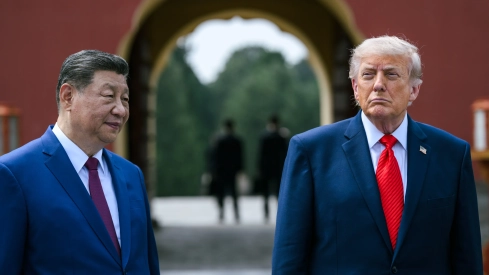
The controversy appears at a delicate moment for the bilateral relationship. Trump visited Beijing in May, publicly praised Xi Jinping, and tried to present the meeting as the beginning of a new stage after the 2025 tariff war. Both governments are now preparing a possible visit by the Chinese leader to Washington in September.
Lin avoided clarifying whether the accusations will jeopardize that trip. He limited himself to repeating that the United States must stop using China during its campaigns. The absence of a confirmation about the visit reflects Beijing's discomfort, although both sides keep their diplomatic and commercial channels open.
Tension has also increased due to new US visa restrictions. The Trump Administration intends to limit the stay of foreign journalists to 240 days, but reduces the permit to only 90 days for Chinese professionals. Beijing considers this difference discriminatory and has warned of possible reciprocal measures.
The SAVE America Act, the true objective of the speech
The accusation against China ended up leading to Trump's main political objective. The president asked Congress to immediately approve the SAVE America Act, an electoral reform that requires presenting documentary proof of citizenship to register and a photo ID to vote in federal elections.
The bill also tightens mail-in voting procedures and increases the federal government's capacity to review electoral records. Republicans argue that these measures strengthen security, while Democrats and civil rights organizations warn that they could make it difficult for millions of citizens to vote, especially older people, women who changed their last name, low-income voters, and residents of rural areas.
The House of Representatives approved the initiative in February by a minimal margin. Its processing was subsequently blocked in the Senate, where Republicans lack the sixty votes needed to close the debate and overcome Democratic opposition.
Trump has since increased pressure on his own party. He even conditioned other laws on the approval of the reform and showed himself willing to assume a new government shutdown. Republicans are now studying incorporating part of the bill into a large budget bill that could pass by a simple majority, a parliamentary route that also raises doubts about the fit of the electoral measures.
The president used his speech to point out those who oppose him. "The only reason not to do it is if you want to cheat," he stated, reducing any criticism to complicity with fraud. The phrase anticipates the climate with which he intends to face the legislative elections in November.
The 2020 defeat re-enters the campaign
Trump clearly won the 2024 presidential elections and at that time did not question the functioning of the system that he now presents as deeply corrupted. His discourse changes when the results harm him. It happened after Biden's victory and reappears when Republicans run the risk of losing the House of Representatives and with it control of parliamentary investigations.
A Democratic majority could block a large part of the presidential agenda, increase oversight of the White House, and push for new procedures against the Administration. Within the Republican Party, there is concern that dedicating the campaign to an election held six years ago will divert attention from the economic issues that will decide a large part of the vote.
Trump has chosen another path. He brings back the 2020 fraud, places China at the center of the conspiracy, and demands more restrictive electoral rules before November. The declassified documents describe real cybersecurity risks and foreign data collection. Proof that Beijing changed votes or took the Presidency from him has yet to appear.
