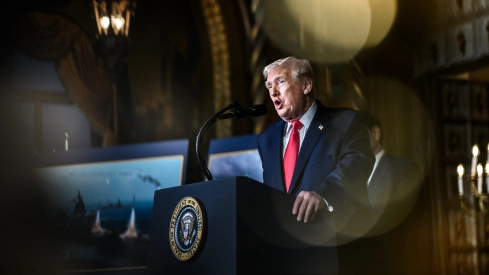
Donald Trump has set a new rule of retaliation for the war with Iran. The United States will destroy an Iranian bridge or power plant each time Tehran's forces attack a ship in the Strait of Hormuz, the president announced amid a military escalation and increasingly weakened peace negotiations.
The threat covers facilities located near or within Tehran and comes after eleven consecutive nights of US bombings. The president has assured that Iran will pay "a very high price" and that it is being "decimated," despite his own Secretary of Defense recognizing that the country retains the capacity to attack bases, ships, and infrastructure throughout the region.
Trump issued these warnings before traveling to Dover Air Force Base to receive the remains of four soldiers killed in Jordan and Iraq. The war has already caused the death of 18 US soldiers and left more than 450 wounded, while Washington still has not set a date for the end of operations.
The president has also reduced internal unrest to its economic impact. "Americans are not against the war," he stated before arguing that citizen concern focuses on the price of gasoline. The gallon has once again exceeded four dollars with only a few months left until the November legislative elections.
A threat that reaches civilian infrastructure
The promise to automatically destroy a facility for each attacked vessel raises new questions about the conduct of the US offensive. Bridges and power plants usually provide essential services to the population, so any attack must demonstrate a specific military purpose and respect the principles of distinction, proportionality, and precaution.
Experts in international law have questioned Trump's announcement of anticipated reprisals without differentiating between military targets and civilian infrastructure. The threat is especially delicate in a war that has already reached energy facilities, desalination plants, and areas near nuclear sites.
US forces have expanded their operations in recent days from the Iranian coast to western and central regions. Central Command claims to have bombed operations centers, hangars, drone warehouses, maritime facilities, and logistical networks intended to threaten commercial navigation.
The province of Bushehr was attacked again last night, including an electrical substation near the country's only operational nuclear power plant. Explosions were also reported near Tehran and in areas of Hamadan, Tabriz, Khuzestan, and the southern ports of Chabahar and Konarak.
The Iranian Ministry of Health reports 53 civilians killed and 592 wounded since the latest resumption of bombings. Among the victims are women and minors, although the United States maintains that its forces do not deliberately target the population.
Iran strikes US bases in three countries
Tehran has responded by extending its operations across the Gulf. The Iranian Army claimed responsibility this Wednesday for attacks against facilities used by the United States in Kuwait, Jordan, and Bahrain, as well as an Amazon data center which it presents as a piece of the Pentagon's technological infrastructure.
In Kuwait, drones targeted Doha camp, where Iran claims to have hit ammunition depots and a command center. It also attacked radars and surveillance systems around Ali al Salem base and on Bubiyan Island.
Jordan reported that its defenses shot down four of the six missiles launched against its territory. The other two fell in uninhabited areas without causing casualties, while Tehran claimed to have caused damage to military installations and destroyed several US drones, a version that Washington has not confirmed.
In Bahrain, Iranian forces attacked for the second time an Amazon data center which they link to the US Central Command. The offensive also hit warehouses and maintenance hangars at Sheikh Isa air base.
These attacks have led the Spanish Government to condemn the Iranian offensive against the Gulf countries and Jordan. The Ministry of Foreign Affairs has called for an "urgent de-escalation", respect for the ceasefire, and a return to negotiation as a way to stop a war that is already extending far beyond Iranian borders.
Hormuz and Bab el Mandeb put global oil at risk
The Strait of Hormuz remains at the center of the conflict. About a fifth of the world's energy supply passes through this route, and the almost total blockade imposed by Iran has driven up transportation costs, maritime insurance, and fuel prices.
Marco Rubio maintains that Tehran intends to control the passage, impose conditions on transit, and set a dangerous precedent for other international routes. The Secretary of State assures that Washington keeps negotiations open, although he accuses Iran of failing to fulfill its commitments and of using the talks to gain time.
The problem has now spread to the Red Sea. The Yemen Houthis, allies of the Islamic Republic, have threatened to prevent the passage of Saudi oil through the Bab el Mandeb strait. Several tankers have changed course due to the risk of being trapped between the two major energy outlets of the Middle East.
Saudi Arabia had moved part of its exports to the port of Yanbu to bypass Hormuz. If ships cannot also cross Bab el Mandeb, they will have to seek longer and more costly routes, with a direct impact on global supply.
Brent crude reached over 95 dollars before moderating its rise. The threat to the two maritime routes has brought back inflationary pressure to the markets and once again places Europe and Asia before the possibility of new energy price increases.
A 32.875 billion war with no exit calendar
The Secretary of Defense, Pete Hegseth, has acknowledged before the Senate that the offensive has already cost 37.5 billion dollars, about 32.875 billion euros. The figure exceeds previous Administration forecasts and continues to increase with each new night of bombings.
Hegseth has asked Congress for another 87.6 billion dollars for the Pentagon. Part of that package would serve to sustain the war and cover salaries and other military needs until the end of September. Without additional funding, he warned, the armed forces will face "critical shortages."
The request has generated criticism among Democrats because Trump has repeated for weeks that Iran was defeated and barely retained military capacity. The head of the Pentagon himself has now had to acknowledge that Tehran maintains sufficient means to prolong the war and strike the United States and its allies.
Rubio insists that diplomacy remains available, but has not offered a concrete roadmap either. Pakistan has confirmed that it will continue to act as a mediator, while Iran demands to retain the control achieved over Hormuz as part of any agreement.
Bulgaria opens a base to US planes
The extension of operations also already reaches Europe. The Bulgarian Parliament has authorized the temporary deployment of eight US KC-135 tanker aircraft and up to 250 military personnel at Bezmer air base, located in the southeast of the country.
The aircraft will be able to remain there from this Friday until October 1 to support US operations in the Middle East. Tanker aircraft allow fighters and bombers to refuel in flight, extending the range and duration of their missions.
The Bulgarian government states that no attacks against Iran will depart from its territory and that no offensive weapons will be installed at the base. Its Minister of Defense maintains that the presence of the planes does not make the country part of the war, an interpretation questioned by the opposition and by several mayors of nearby municipalities.
Iran has warned that any assistance provided to US operations would make Bulgaria an accomplice in the offensive. Despite that threat, the deployment was approved by 136 votes to 13, with two abstentions, and will begin while Washington maintains its daily attacks.
Pakistan will continue its contacts with both parties to try to resume negotiations. Until then, the United States is preparing new operations, Iran is maintaining its retaliations, and the first US planes will begin to arrive at the Bulgarian base of Bezmer this Friday.
Add ElConstitucional.es as a preferred Google source for free.
Stay informed about all the latest breaking news with the best information. Against disinformation, for democracy and social rights.
