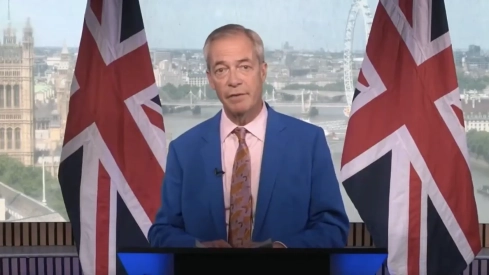
Nigel Farage announced this Tuesday his resignation as Member of Parliament for Clacton-on-Sea, but he is not leaving politics. The leader of the far-right Reform UK is stepping down from his seat to force a by-election and run again in his electoral stronghold, amidst an ongoing investigation into millionaire gifts and undeclared financial support.
The maneuver bears Farage's stamp. Cornered by questions about his donors, the Brexit agitator is trying to move the case from regulatory bodies to the ballot box. His message is the same as always: him against the media, him against Westminster, him against everyone. “The people against the establishment,” he said in a speech without questions from the press.
The resignation comes after the Parliamentary Commissioner for Standards opened an investigation into a gift of five million pounds received in 2024 from businessman Christopher Harborne, a cryptocurrency billionaire residing in Thailand. Farage maintains that it was a personal gift, without conditions, and that he was not obliged to declare it as an MP.
The case has been complicated by another uncomfortable name for Reform UK. George Cottrell, a former associate of Farage and an entrepreneur also linked to the crypto world, was convicted in the United States for wire fraud. According to reports published in the UK, he would have provided the far-right leader with security support, staff, social media, travel, and accommodation. This is one of the key aspects of the file: whether these supports were personal or if they served to sustain his political activity.
The plebiscite trick
Farage tries to present his resignation as a gesture of democratic courage. In reality, the move allows him to change the framework of the conversation. He no longer wants to talk only about donations, parliamentary rules, or potential conflicts of interest. He wants Clacton to vote on whether they believe him or not, and to use that vote as political endorsement against any investigation.
Reform UK has reinforced this narrative with a very calculated message: “The people of Clacton will be the judge of Nigel Farage’s political integrity, not the establishment in Westminster.” The letter circulated by the party repeats the same script, with Farage portrayed as a victim of persecution by the media, Labour, the elites, and the system.
The people of Clacton will be the judge of Nigel Farage’s political integrity — not the establishment in Westminster. pic.twitter.com/1MgYhE6oH3
— Reform UK (@reformparty_uk) July 7, 2026
That victimhood is not new. Farage has spent two decades turning every crisis into political fuel. He did it with Brussels, with Brexit, with immigration, and now he does it with his own finances. The mechanism is simple and effective for his electorate: if he is investigated, it is because he is bothering someone; if his donors are published, it is because they want to destroy him; if he has to explain five million pounds, the fault again lies with the elites.
The gamble, however, carries risk. Farage won Clacton in 2024 with strength, but this time he will run amidst the noise of investigations and with a more fragmented British far-right. Reform UK leads national polls and has capitalized on Labour and Conservative weariness, although it is also starting to face pressure from its right with Restore Britain, the split from Rupert Lowe.
From Brexit to millionaire donors
Farage is not just another MP. He was one of the decisive faces of Brexit, the politician who for years pushed the Conservative Party towards a break with the European Union and turned the anti-immigration discourse into a central current of British debate. After several comebacks, Reform UK has now returned him to Westminster with a much greater ambition: to challenge Labour and Conservatives for power.
That is why the case weighs so heavily. The questions about Harborne and Cottrell strike right where Farage tries to build his brand: the idea that he represents ordinary people against old, corrupt, and disconnected politics. The far-right leader accuses others of belonging to the system, but his own circle appears to be riddled with crypto millionaires, opaque gifts, private support, and friendships with criminal records.
In his appearance, Farage has denied doing anything illegal and has argued that making money is not a crime. He has also said that part of the money was intended for his personal safety and that of his family. The political problem is not just strict legality. It is in whether a leader who aspires to govern can receive millions and benefits from large fortunes without subjecting them to complete transparency.
The still prime minister, Keir Starmer, has called the operation a “desperate maneuver” and other British parties see it as a smokescreen to avoid answering to parliamentary bodies. Farage has already chosen his ground. He doesn't want an interrogation in Westminster. He wants a campaign in Clacton with him at the center and the system as the enemy.
The by-election will be called in the coming weeks. Farage will run again.
