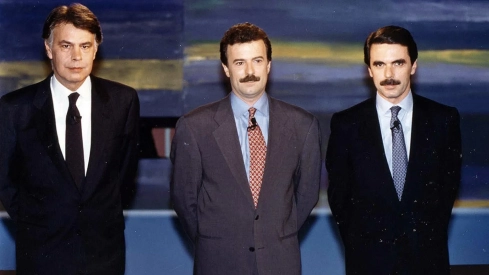
The face-to-face we will experience today, November 19, between the President of the Government Pedro Sánchez candidate for re-election by the PSOE, and Alberto Núñez Feijóo, candidate for the presidency of the Government by the PP will be the seventh face-to-face of democracy. It will be organized by the television academy, hosted by María Casado.
The first of them was held on May 24, 1993, on Antena 3, presented by Manuel Campo Vidal, on Antena 3, between the then President of the Government Felipe González and the leader of the opposition José María Aznar.
This first face-to-face of democracy was won by José María Aznar who managed to corner a Felipe González who was still in shock, having been on the verge of crashing the plane that was transporting him from the Canary Islands. It was commented that in this first debate Felipe González underestimated José María Aznar and this was one of the reasons why public opinion considered the popular leader victorious.
The second round took place on May 31, on Telecinco presented by Jesús Mariña when a more skilled Felipe González had thoroughly studied the Popular Party's electoral program, and when he asked Aznar specific questions about his program, the popular leader was hesitant.
A much more aggressive Felipe González attacked the popular leader with his pension model, finally in this second debate the polls gave victory to the socialist leader who would win the elections on June 9, 1993.
We would have to wait until 2008 for two new face-to-face debates to be held, this time between the acting President of the Government José Luis Rodríguez Zapatero, and the leader of the opposition Mariano Rajoy.
These debates took place on February 25 and March 3, presented respectively by Manuel Campo Vidal and Olga Viza, organized by the Television Academy. In both debates, the polls gave José Luis Rodríguez Zapatero the victory over Rajoy, whose last speech, referring to how he wanted a girl's future, became one of the first memes on the Internet.
Both debates focused on economic discussions and the Government's anti-terrorist policy.
On November 7, 2011, the debate was held between Alfredo Pérez Rubalcaba, candidate of the Socialist Party, who had been vice president and minister of the interior in Zapatero's Government, and Mariano Rajoy, who was running in his third consecutive election. The debate revolved around the alleged cuts that the Popular Party would make if it won the elections; this was Rubalcaba's main dialectical resource against Rajoy, to whom all polls gave a wide absolute majority that finally materialized on November 20 of that year.
On December 15, 2015, again held at the Television Academy and presented by Manuel Campo Vidal, the debate was held between President Mariano Rajoy, candidate of the PP, and the leader of the opposition Pedro Sánchez, who was running in his first elections. The debate was marked by the corruption cases of the Popular Party, and Sánchez's statement that "Spain deserves a president who is decent and you are not" became controversial. Mariano Rajoy would win the elections but without enough majority to form a government, so the elections were repeated in June 2016, this time without any face-to-face debate.
In the 2019 elections, a 4-way format was chosen, as the emerging parties Ciudadanos and Podemos had gained great public prominence. The elections were won by the Socialist Party, although they had to be repeated in November as no agreement was reached between PSOE and Unidas Podemos.
The face-to-face format returned in 2023; on July 10, President Pedro Sánchez faced Alberto Núñez Feijóo for the first time, in a debate organized by Atresmedia and hosted by Vicente Vallés and Ana Pastor. The debate was tense, marked by Sánchez's pacts with the independence movement and his references to Feijóo's photograph with a drug trafficker years ago, as well as the pacts that the Popular Party made with Vox in the autonomous communities.
Finally, the elections were won by the Popular Party, but by not being able to reach an agreement with Vox, the Socialist Party with Pedro Sánchez at the head was able to revalidate the Government through parliamentary agreements with the independentists.
AUDIENCES OF FACE-TO-FACE DEBATES IN SPAIN (1993–2023)
Source: Barlovento Comunicación / Kantar Media
1. 24/05/1993 | Felipe González vs. José María Aznar | 9,625,000 viewers | 61.8% share | Antena 3
2. 05/31/1993 | Felipe González vs. José María Aznar | 10,526,000 viewers | 75.3% share | Telecinco
3. 02/25/2008 | José Luis Rodríguez Zapatero vs. Mariano Rajoy | 13,043,000 viewers | 59.1% share | 20 channels (simulcast)
4. 03/03/2008 | José Luis Rodríguez Zapatero vs. Mariano Rajoy | 11,952,000 viewers | 56.3% share | 22 channels (simulcast)
5. 11/07/2011 | Alfredo Pérez Rubalcaba vs. Mariano Rajoy | 12,005,000 viewers | 54.2% share | 17 channels (simulcast)
6. 12/14/2015 | Pedro Sánchez vs. Mariano Rajoy | 9,728,000 viewers | 48.7% share | 12 channels (simulcast)
7. 07/10/2023 | Pedro Sánchez vs. Alberto Núñez Feijóo | 5,911,000 viewers | 46.5% share | Antena 3 and laSexta
Contact