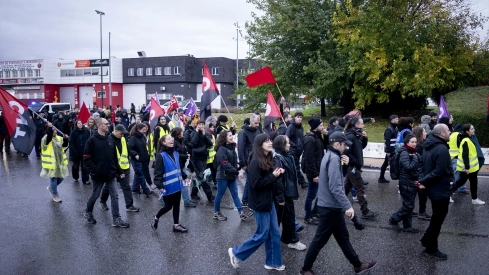
The contemporary history of Spain and the rest of Europe cannot be understood without the struggle of labor and social movements, especially from the 19th century onwards, in the midst of the Industrial Revolution, to achieve labor improvements and social rights.
The general strike has also been a tool used in very different contexts, from the socialist and anarchist labor movement to the democratic unions that emerged during the Transition.
The first trade union antecedent in Spain was the Barcelona weavers' association, framed within the textile sector, founded in 1840, during a process of industrialization of the country, where workers' rights lacked appropriate regulation.
1855: Spain's first general strike
One must go back to the reign of Isabel II to find the first major precedent of a general strike in Spanish territory.
In July 1855, workers in Catalonia, especially those in Barcelona and its industrial surroundings, led an unprecedented mobilization. The expansion of the textile industry had given rise to a new working class that endured long hours, reduced wages, and very harsh working conditions.
The origin of the strike was the mechanization of the spinning process, which reduced jobs, a phenomenon that was occurring throughout Europe due to increasing technological development.
The political context, in principle, was favorable for workers' demands, as it occurred during the progressive biennium (1854-1856) with Baldomero Espartero as Prime Minister; however, the authorities in Catalonia, such as Captain General Juan Zapatero or the civil governor of Barcelona, began to limit the freedoms of labor movements and impose repressive measures against workers' associations, especially the prohibition of workers' societies.
Under the slogan «Association or death», the workers demanded the recognition of the right to free unionization.
The mobilization spread through numerous Catalan industrial centers and was repressed by the authorities. Even the bishop of Vic appealed to Christian cooling to convince the workers to return to work. The strike ended in mid-July 1855 when General Espartero, through Captain Sarabia, promised to improve working conditions, but these promises fell on deaf ears and the repression continued.
The 1917 strike: revolutionary sounds
In 1917, the latter in the context of Spanish neutrality during the First World War, which, although economically favorable for Spain, was not perceived as such by the working class, which remained in a situation of great precariousness. The strike was called by the UGT (General Union of Workers) union and the PSOE. The strike was called on August 13, 1917, preceded by a strike by Valencian railway workers in protest against the non-admission of several workers by the railway company. The strike had a revolutionary character and involved the army. King Alfonso XIII replaced the conservative Eduardo Dato with Emilio García Prieto. Members of the strike committee who were sentenced to life imprisonment, among whom was Largo Caballero, were included in the PSOE's electoral lists for the 1918 elections, which forced the government to grant them amnesty.
Finally, the labor movement would achieve the conquest of the eight-hour workday in 1919, which is still in force today.
1934: the revolutionary strike and Asturias
The Second Republic was also not exempt from enormous social conflict. One of the most transcendental episodes took place in October 1934.
The entry of three CEDA ministers into the Government presided over by Alejandro Lerroux was interpreted by a large part of the labor organizations as a threat to the Republic and the social reforms promoted since 1931.
On October 5, a revolutionary general strike called by socialist organizations began. However, its development was very uneven depending on the territory.
In Asturias, it acquired a particularly important dimension. There, the alliance between socialists, communists, and anarchists, known as the Workers' Alliance, allowed for the organization of an insurrection that came to control numerous towns and mining centers.
The conservative Government responded by sending the Army to quell the movement. The military intervention, in which troops from North Africa participated, was accompanied by a very harsh repression, sponsored by General Franco.
The Asturian Revolution left thousands arrested and a high number of dead. Its defeat constituted one of the events that deepened the political and social division of Spain during the Second Republic.
Strikes during Francoism
Francoist legislation expressly prohibited the right to strike as well as the creation of trade unions. The only legal one was that of the regime itself, the so-called vertical union that included both employers and workers, its purpose was to avoid class struggle, but it did not prevent workers and clandestine unions from organizing numerous strikes and protests at different times, both to improve their working conditions and as a form of protest against the Francoist dictatorship. In this context, the Comisiones Obreras union, linked to the Communist Party of Spain, was founded in 1962, whose leaders suffered a harsh judicial process in 1973, which condemned them to prison, among them the historic leader Marcelino Camacho.
1976: workers lead the Transition
The death of Francisco Franco in November 1975 opened a period of political uncertainty and institutional transformation.
In this context, the labor movement played a fundamental role in the demands for union freedom, amnesty, democracy, and economic improvements.
On November 12, 1976, the Coordinator of Trade Union Organizations, made up of CCOO, UGT, and USO, promoted an important day of mobilization against the economic policy of the Adolfo Suárez Government.
The protest took place at a time of high inflation, unemployment, and labor unrest.
Economic demands coexisted with others of a political nature, such as the demand for democratic freedoms and the legalization of trade union organizations.
1985: the first major general strike of democracy
The 1978 Constitution had recognized the right to strike, but it was not until June 20, 1985, that the first major 24-hour general strike of the democratic era occurred.
Felipe González's Government had promoted a Social Security reform that extended the period used to calculate retirement pensions from two to eight years.
CCOO led the call, joined by other trade union organizations. UGT, linked to the PSOE, however, did not support the mobilization.
1988: the historic December 14th
If there is a general strike that holds a special place in the collective memory of Spanish democracy, it is that of December 14, 1988, popularly known as 14-D.
The call by CCOO and UGT, (led by the socialist Nicolás Redondo) against Felipe González's Government, with Manuel Chaves as Minister of Labor, was an extraordinary event.
The trigger was the Youth Employment Plan, which contemplated hiring formulas for young people that the unions considered precarious.
However, the demands were much broader: wage improvements, protection against unemployment, increased pensions, and a change in the Government's economic policy.
The mobilization was massive. Industrial activity, transport, and numerous services were practically paralyzed. Even RTVE interrupted its usual programming.
The success of the call forced the Executive to withdraw the Youth Employment Plan and opened a period of negotiation between the Government and trade union organizations.
14-D thus became a symbol of the workers' capacity for pressure during democracy.
1992: protest against unemployment cuts
On May 28, 1992, CCOO and UGT again called a general strike against the socialist Government.
On this occasion, the protest had a different duration depending on the sectors and territories, although its general format was a half-day.
The main reason was the reform of unemployment benefits, which meant a tightening of the conditions for accessing them and a reduction of certain benefits.
1994: a new strike against labor reform
On January 27, 1994, CCOO and UGT called another general strike against the socialist Executive's economic and labor policy.
The main reason was the reform of the labor market, which included modifications in hiring, greater labor flexibility, and changes in dismissal conditions.
The call had a significant impact on industry and transport, although follow-up was uneven in other sectors.
The participation figures offered by unions and the Government were very different.
Despite the mobilization, the Executive maintained a good part of its reforms.
2002: José María Aznar's "decretazo"
On June 20, 2002, Spain once again experienced a 24-hour general strike. This time, the recipient of the protests was the Popular Party Government presided over by José María Aznar, with Juan Carlos Aparicio as Minister of Labor.
The reason was Royal Decree-Law 5/2002, popularly known as the "decretazo" (decree-law).
The reform modified the unemployment protection system and tightened certain conditions for accessing benefits.
The unions considered that the measures particularly harmed unemployed workers and reduced their social protection.
CCOO and UGT led the call, which managed to paralyze a good part of industrial and transport activity.
The mobilization had important political consequences and contributed to increasing tension between the Government and union organizations.
Finally, some of the most controversial provisions were modified or withdrawn.
2010: the strike against Zapatero's labor reform
The international economic crisis had hit Spain hard. Unemployment was rising, the real estate sector had collapsed, and the Government of José Luis Rodríguez Zapatero had begun to implement adjustment measures in response to the severe economic crisis of 2008.
On September 29, 2010, CCOO and UGT called a general strike against the labor reform approved by the Executive.
The unions rejected the measures that facilitated dismissals, modified working conditions, and expanded business flexibility.
2012: two general strikes against Mariano Rajoy
Mariano Rajoy's Government had to face two general strikes during 2012.
The first took place on March 29, just three months after his arrival at La Moncloa.
The labor reform approved by the Executive was the main reason for the call. The unions denounced the cheaper dismissals, the loss of workers' bargaining power, and the increase in business capacity to modify working conditions.
The second took place on November 14, 2012, and developed in the context of austerity policies and budget cuts.
The latter had an international dimension: Spain coincided with general mobilizations in other European countries, especially in Portugal, Greece, and Italy.
The two days were important expressions of rejection of the Popular Party Government's economic policy.
However, the reforms were not withdrawn; thus, the labor reform was modified in 2022, promoted by Vice President and Minister of Labor Yolanda Díaz.
That of November 11, 2026, will be added to this long list of general strikes.
Contact