Three years after the attack of October 7, 2023, perpetrated by Hamas, it continues to generate debate about the origins of the conflict between Israelis and Palestinians. Understanding it requires distinguishing between religious traditions, ancient history, and contemporary political conflict.
The sources of ancient Israel's history come from the Old Testament, which combines religious tradition, historical memory, and theological elaboration. Archaeology allows us to place a kingdom associated with David and Solomon in the 10th century BC, divided after the death of the latter into Israel and Judah. The kingdom of Israel was conquered by Assyria in 722 BC and Judah by Babylon in 586 BC. King Nebuchadnezzar II deported the Jewish population to the center of the Babylonian empire, and it was in this context that the Jewish sacred scripture, which for Christianity is the Old Testament, began to take written form.
In 539 BC, Cyrus the Great, emperor of Persia, conquered Babylon and the region came under Persian control.
Cyrus allowed the return of the Jewish captives, which meant the restoration of the Jewish religion and Israel. In 332 BC, Alexander the Great, king of Macedonia, conquered Jerusalem, incorporating it into his Hellenic empire.
When Alexander the Great died, the territory of Israel came under the control of the Ptolemaic dynasty, founded by one of Alexander the Great's generals, which was established in Egypt; however, in 198 BC, the territory was controlled by the Seleucid empire, founded by another of Alexander the Great's generals.
The Seleucid empire carried out a policy of forced Hellenization, which for the Jews meant a way of violating their tradition and religion. In this context, the Maccabean revolt (167) occurred, which managed to emancipate the territory, giving rise to the Hasmonean dynasty, which established a period of Jewish independence. Rome conquered Jerusalem in 63 BC.
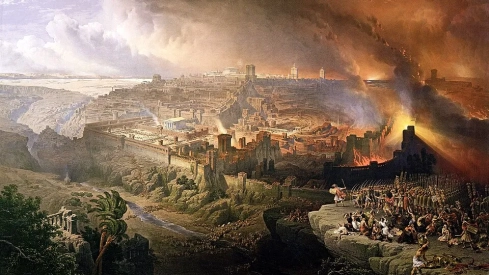
The Judeo-Roman wars culminated in the destruction of the Second Temple of Jerusalem in 70 AD. After the Bar Kokhba revolt (132-135), Emperor Hadrian reorganized the Roman province and officially adopted the name Syria Palaestina. The term "Palestine" had earlier antecedents and was etymologically related to denominations linked to the Philistines. However, Hadrian's administrative decision turned Palaestina into a Roman provincial denomination of enormous later significance.
After Roman and Byzantine rule, Jerusalem was conquered by the Muslims in 638. In 1099 the Crusaders took the city and established the Kingdom of Jerusalem. Saladin recovered it in 1187 and the Mamluks ended the last Crusader States in 1291. In 1516, the Ottomans defeated the Mamluks and Palestine was integrated into the Ottoman Empire for four centuries.
World War I again changed the map. The Ottoman Empire was defeated and dismembered; British troops occupied Palestine between 1917 and 1918. In 1922, the League of Nations formally granted Great Britain the Mandate over Palestine, which came into force in 1923.
At the end of the 19th century, Zionism emerged, promoted among others by Theodor Herzl, who advocated for a Jewish national home in Palestine. During the British Mandate, Jewish immigration increased, especially in the face of European persecution and the Holocaust, while Arab national claims also grew.
In 1947, the UN recommended dividing Palestine into a Jewish and an Arab state, with Jerusalem under international rule. In 1948, Israel was born and neighboring Arab countries declared war on Israel, thus expanding the territory under its control, and hundreds of thousands of Palestinians fled or were expelled, an episode known as the Nakba.
After the Six-Day War in 1967, Israel occupied the West Bank, East Jerusalem, and Gaza. Subsequently, Israel authorized the creation of the Palestinian National Authority to manage the territories of the West Bank and Gaza, but this did not prevent the "intifadas," a series of civil guerrilla actions that evolved into terrorist actions, which maintained tension in the territory. The response to these acts by Israel has been considered excessive by international actors, the maximum exponent being the response to the October 7 attack, which has caused the death of 70,000 people and has left Israel (with the exception of usual partners such as the US and Germany) very weakened in terms of diplomatic sympathies.
On this third anniversary of the attack, it does not seem likely that the proposal for two states (one Israeli and one Palestinian) will develop, much less a unified binational state, which from the Israeli perspective would mean the fading of the nation's Jewish character.