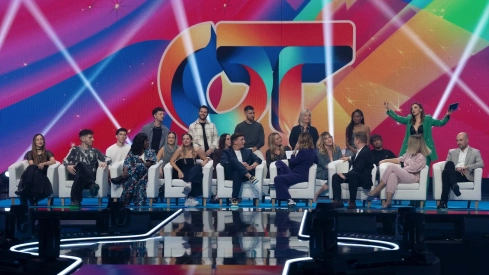
On October 22, 2001, Televisión Española premiered a program that would transform Spanish television. Under the name of Operación Triunfo, and presented by Carlos Lozano, 16 unknown young people entered an academy to train as singers, live together in front of the cameras and be able to achieve a recording career, and be able to represent Spain in Eurovision.
No one could imagine that this television experience would end up becoming one of the most recognizable entertainment formats in Spain.
The mechanics of the contest were as follows: each week the contestants generally sang a song in pairs that they rehearsed throughout the week and the academy. In the gala, a professional jury nominated four contestants whom they proposed to leave the academy, whose director was the singer Nina.
Of those four contestants, the teachers saved one, the classmates saved a second, and the third saved was decided for the following week after the audience could vote for one or the other. In this way, the audience could get emotionally involved in the journey of artists from their first rehearsals to their entry into the professional market.
In the memory of that first edition, there are mythical performances such as “Escondidos” interpreted by Chenoa and David Bisbal -who would be a couple for a few years-, “Noches de bohemia” interpreted by Manu Tenorio and Nuria Fergó, or “Ausencia” by Rosa López.
For the memory of this edition, the choral song “Mi música es tu voz” will remain, converted into an anthem.
The birth of a television phenomenon
The first edition, produced by Gestmusic and broadcast by TVE, began with an apparently simple proposal: gather young aspirants in an academy, subject them to intensive musical training and show their evolution weekly to the public. However, the combination of coexistence, learning, competition and live performances turned the format into a collective experience.
The success was extraordinary. The first edition reached an average close to 6.9 million viewers and around 44% of screen share, with a final that exceeded 12 million viewers and touched 69% of share. Unimaginable data today.
The program quickly transcended the screen. The songs from the galas became commercial hits, the compilation albums occupied the top sales positions and the contestants starred in massive tours.
Television had found a formula capable of combining spectacle with personal identification. The public was not limited to listening to songs: they emotionally connected with one contestant or another, being able to make them a favorite of each gala (which made them untouchable at the time of nomination) or save them from nomination.
However, the format was not without criticism; many established singers criticized the program for the immediate stardom it offered contestants, and also for the price of the program's albums, which was much lower than the market average.
This meant that for many years being "triunfito" has often been a stigma, especially for the lesser-known contestants.
Three seasons and a dream called Eurovision
After the success of the first edition, in October 2002, a second edition kicked off. The accident suffered by several contestants in one of the first galas when they fell from a stage ladder will be remembered. The contestant who was most often a favorite in this edition was the Canary Islander Tony Santos, who ultimately could not reach the final, which was won by Ainhoa Cantalapiedra, with Manuel Carrasco in second place.
Mai Meneses deserves a separate mention; although she was the first to be expelled, she triumphed with the group Nena Daconte a few years later.
The second edition again fueled the relationship between the contest and Eurovision. Beth, with "Dime," represented Spain in Riga and finished in eighth position. A year later, in 2003, the third and final edition of the format on Spanish Television began, already somewhat affected in audiences. In this edition, the format changed, giving the public all the protagonism when it came to nominating the four contestants.
The edition was won by Vicente Seguí from Valencia, and the Eurovision representative was Ramón del Castillo, who represented Spain in Istanbul in 2004 with the song "Para llenarme de ti." With the third edition, that first stage of Eurovision selection linked to OT concluded. The program would continue its path, and Eurovision would later seek other formulas to choose its representatives.
The leap to Telecinco: a new stage for the format
In 2005, after three editions on TVE, Operación Triunfo changed channels and landed on Telecinco. The transfer posed a challenge: maintaining the identity of the contest on a commercial television with a different programming and entertainment strategy.
The format retained its fundamental elements but progressively adapted to the channel's style. Galas, personal stories, and rivalries gained more weight within an increasingly competitive television offering. The program remained a musical showcase, although it also integrated into a television where conflict and conversation around the characters had increasing value.
This first edition of Operación Triunfo on Telecinco was marked by controversy with Idaira, a Canary Islands contestant who was the public's favorite for weeks but was harshly criticized by the jury, and whose treatment was even rejected by the Cabildo of the island of Tenerife.
This edition, which gave way to singers like Edurne or Soraya Arnelas, was won by fellow Canarian Sergio Rivero.
OT was still a success, but it was no longer an absolute novelty. It needed new ingredients to continue generating interest. It was in this scenario, when in the edition that began in 2006, an until then unknown member of the jury caught attention: Risto Mejide, who soon gained popularity for his biting evaluations, which had no filter whatsoever, even criticizing the contestants' wardrobe, song selection, and even the work of the academy's teachers, which led to confrontations with its then-director Kike Santander.
The edition was won by the singer from Lleida, Lorena Gómez.
2008: Virginia Maestro, Risto Mejide and an edition marked by controversy
The 2008 edition represents one of the most remembered chapters in the history of the contest. It was a season with good audience results, but also with a controversy that modified the conversation around the program.
The incorporation of Risto Mejide to the jury had introduced a particularly incisive figure. His evaluations, usually harsh and provocative, became one of the main focuses of attention of the galas, something that had already been happening since the previous season.
The edition also stood out for the coexistence problems within the academy, which on this occasion was directed by the acting teacher Ángel Llacer, who also had confrontations with Risto.
Part of the conversation in this edition was about the bad relationship of contestant Virginia with the rest of her companions, especially with Iván Santos. To this had to be added that Risto Mejide publicly supported Virginia, which led to further souring the relationship between the contestants.
Also widely commented was the passage of the Malaga native Esther Aranda, who in the first gala together with her partner
One of the contestants of this edition who would later gain greater popularity would be the Malaga native Pablo López.
Virginia ended up winning the edition against Chipper, in a final that gathered 4.28 million viewers and reached a 34.4% share.
The 2009 edition once again featured a Risto Mejide, but perhaps with less impact on the public and the contestants as the surprise effect produced by his evaluations had already worn off. However, one of the most commented clashes of that edition occurred between this jury member and the program's presenter Jesús Vázquez, after Risto had uttered a comment -If I were in that academy I would have my holes closed- in clear allusion to the homosexuality of the academy director. Jesús Vázquez did not overlook it and they starred in one of the most tense confrontations in the program's history, which caused Risto not to return for the final.
This edition featured Cristina Rueda from Marbella, whom we would see years later in the series Mesías by Los Javis, and the winner Mario Álvarez who would later become part of the Panorama orchestra. OT showed that both dimensions could coexist, although not always peacefully.
2011: the wear and tear and cancellation of a historic format
The eighth edition came with changes in the presentation, the jury, and the program's dynamic. Pilar Rubio took on the role of presenter and Nina returned to the academy, but the renovation failed to regain the interest of the first seasons.
The figures reflected the wear and tear. The 2011 edition began with 2.78 million viewers and a 17.3% share, but subsequent galas lost audience. The fourth installment fell to 12%, a historical low for the contest until then.
Telecinco decided to cancel the edition early and schedule a final gala to bid farewell to the format. On February 20, 2011, Operación Triunfo closed that stage with Nahuel Sachak's victory, after barely six broadcasts.
The farewell left a feeling of a premature end. A program that had managed to bring together millions of people and transform unknown young people into musical stars could not find its place on a television that had changed profoundly.
One of the contestants who subsequently had the most projection in this edition was Mario Jefferson, especially talented at avoiding other singers given the versatility of his voice.
2016: Nostalgia opens the door to return
The first sign that OT retained its convening power came with OT. El reencuentro (The Reunion), broadcast by TVE in October 2016 to celebrate the fifteenth anniversary of the first edition.
The documentaries brought together the former contestants and recovered their memories, their personal relationships, and the consequences that experience had had on their lives. The concert that capped it off completed an exercise in collective memory that piqued the interest of those who had followed the program in its beginnings, becoming especially popular at the moment when Chenoa tried to kiss David Bisbal and he turned his face, which the public interpreted as a "cobra."
The reunion showed that there was an audience willing to return to OT. And it also allowed TVE and Gestmusic to verify that the format could regain its appeal if it adapted to new forms of audiovisual consumption.
2017: The reinvention that brought OT back to the forefront
On October 23, 2017, Operación Triunfo returned to La 1 with a new generation of contestants and an idea that would prove decisive: the academy could no longer be limited to existing within traditional television.
With Roberto Leal at the helm and Noemí Galera as director of the academy, the program recovered its musical essence, but introduced a digital strategy that changed the relationship between viewers and participants.
The YouTube channel with continuous broadcasting from the academy, rehearsals, song assignments, mic passes, and content shared on social networks allowed the public to accompany the contestants throughout the week. The galas ceased to be the only important event: any rehearsal could go viral, and a performance could generate conversation for days.
In this edition, the visibility given to the LGTBI collective was important, as it had several homosexual contestants in the academy. Especially striking was when Agoney and Raoul kissed during the song "Manos vacías" (Empty Hands), which represented an attempt to normalize affective-sexual relationships between people of the same sex.
Although the couple formed by Alfred and Amaia was probably the one that won the hearts of the viewers.
The names of Amaia Romero, Aitana, Alfred García, Ana Guerra, Miriam Rodríguez, and Agoney quickly became part of popular conversation. Performances such as Amaia and Alfred's rendition of "City of Stars" showed that the program could generate viral phenomena without exclusively relying on live broadcast.
The traditional audience also responded. The edition registered an average of approximately 2.55 million viewers and a 19.7% audience share. Its finale, in which Amaia was declared the winner, reached 3.925 million viewers and a 30.8% share. More than 7.7 million people tuned in at some point to that last gala. However, its greatest potential was demonstrated on social media, being the main topic of conversation on the Twitter social network throughout its broadcast.
On this occasion, OT was once again linked to Eurovision. Thus, the audience decided that the couple Alfred and Amaia would represent Spain in Lisbon in 2018, with the song "Tu canción" (Your Song), surpassing "Lo malo" (The Bad Thing) which still became a commercial hit in the summer of 2018.
The contestants' songs were played throughout the summer of 2018, with Mimi's case being particularly noteworthy, as she, rebranded as Lola Índigo, triumphed with her song "Ya no quiero na'" (I don't want anything anymore) and became one of the most widely diffused singers of the edition, along with Aitana.
The success of 2017 was especially significant because it did not consist of recovering the figures of 2001, but in demonstrating that OT could be relevant in a completely different audiovisual ecosystem.
2018 and 2020: The consolidation and limits of the return
The success of 2017 made a new edition possible in 2018. The formula maintained the elements that had worked: musical training, cohabitation, performances, and intense digital activity.
However, repeating the phenomenon was not easy. The second season of this new stage registered an approximate average of 1.96 million viewers and a 16.4% screen share, below the results of its predecessor. Famous was proclaimed winner in an edition that also gave visibility to artists such as Natalia Lacunza, Alba Reche and María Escarmiento, who starred in one of the most commented moments, when she asked to substitute the word “mariconez” (faggotness) within Mecano's song “Quédate en Madrid” (Stay in Madrid) for stupidity, to edit the stigmatizing use of the word, to which the author of the song José María Cano refused.
In 2020, a new season arrived, marked by the difficulties derived from the COVID-19 pandemic. The edition began before the health crisis forced a temporary interruption of the usual development of the academy and galas. The program resumed its activity after the suspension, but the exceptional context conditioned a season that ended with the victory of Nia Correia.
Audiences fell again and the contest closed its stage on conventional television without immediate continuity being guaranteed.
OT had survived a first cancellation, a change of channel and a triumphant return. Now it faced another question: how to continue being a great musical event when the public could choose between linear television, platforms, social networks and on-demand content.
2023: The historic leap to Prime Video
In 2023, Operación Triunfo undertook a new transformation by abandoning free-to-air television to move to Prime Video. The change was not merely technological: it meant modifying the way of accessing the program and the relationship between the contest and its audience, by being broadcast for the first time on a paid platform.
The 2023 edition, presented by Chenoa, became the first major live music talent show broadcast on a streaming platform in Spain. The weekly galas coexisted with daily content and continuous monitoring of the academy, while viewers could retrieve performances and highlights on demand.
The data released by Amazon pointed to a positive response. The company estimated that more than 3.5 million unique viewers followed the edition during its fourteen weeks, and that 85% of them returned weekly. It also reported that the official application reached 1.6 million users and that the program's hashtag accumulated 5 billion views on TikTok.
The winner of that edition was Naiara, who won in February 2024 and became the first winner of this new digital stage.
Other contestants who left their mark were Paul with his overwhelming interpretive personality, Chiara whose campaign to save her from a nomination reached the screens of New York, or the couple formed by Juanjo Bona and Martín Urrutia.
2025: Continuity and new forms of consumption
The 2025 edition confirmed the continuity of OT on Prime Video, with Chenoa again as presenter and Cristina as winner. The platform and the production company continued to work on a formula that combined galas, life in the academy, and the digital participation of followers. However, part of the audience highlighted that the contestants of this last edition were all especially well-trained in music, which for some essentially distorted the first editions of the program, in which contestants like David Bustamante came from construction or David Bisbal from gardening, that is, neighborhood kids with whom perhaps a part of the public could feel more identified, although it should also be said that society and access to higher education may not be the same in 2025 as in 2001.
Twenty-five years of careers, songs, and collective memory
The history of Operación Triunfo cannot be measured solely by its audiences or by the number of winners. Its influence is also found in the careers it has helped to boost and in the artists who have followed their own paths after leaving the academy.
From David Bisbal, Bustamante, Chenoa, and Manuel Carrasco to Aitana, Lola Índigo, Pablo López, and Amaia, the format has served as a starting point for very different musical trajectories. Some have achieved massive commercial success; others have developed more personal careers or careers linked to specific audiences.
There is, furthermore, a generational dimension. For those who followed the first edition in 2001, OT is associated with an era of records, calls to vote, massive galas, and songs that remained for months in the collective memory. For those who discovered the program in 2017 or through Prime Video, the experience has been linked to YouTube, TikTok, rehearsal videos, and the permanent follow-up of their favorite contestants.
Its history has not been an ascending line. There have been extraordinary successes, seasons of wear and tear, controversies, changes of direction, and moments when its continuity seemed uncertain. Precisely for this reason, its permanence is significant.
The next edition of Operación Triunfo is set in principle for October 2027, so there is one year left for the format to look for sixteen young people who seek to make a place for themselves in the music industry, and surely become part of the country's social conversation.