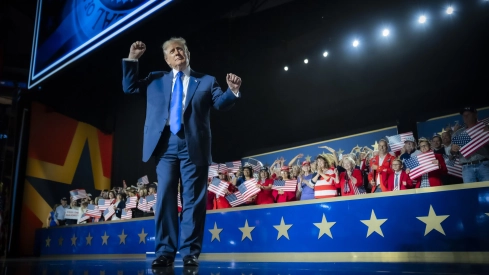
On October 9, U.S. President Donald Trump led an official event in the East Room of the White House to celebrate Columbus Day. During the ceremony, the president praised the figure of the navigator, calling him a "hero" who "changed the future of humanity forever."
Trump emphasized that the 1492 voyage—carried out by a crew of barely 90 men—constitutes one of the greatest feats in history. He defended that Columbus's legacy should be viewed with pride and flatly rejected criticism from mainly indigenous sectors, who seek to link his name with negative concepts, and who have taken actions against Columbus's legacy, such as the tearing down of his statues. According to his own words, his administration has managed to "resurrect" his memory in a political climate where previously "his name could not even be pronounced."
During the event, which was attended by prominent representatives of diplomacy, politics, and the Italian-American community—as well as the Ambassador of Spain to the U.S., Ángeles Moreno—the president announced the installation of an 1860 marble sculpture of Columbus in the White House gardens, alongside the figures of George Washington, Benjamin Franklin, Thomas Jefferson, and Abraham Lincoln. This initiative joins the statue already placed in the vicinity of the White House, a replica of a statue torn down in Baltimore in 2020 during the racial protests of that year.
Trump's contradiction
Historically, the vindication of Columbus in the United States has been driven by emigrated Italian communities, who saw in the Genoese-born sailor a symbol to combat discrimination and strengthen their identity within the country. However, Trump's exaltation of his figure contains a marked contradiction:
Regardless of the roots attributed to Columbus, the historical expedition that transformed the world map was directly sponsored by the Spanish Crown. Exalting the feat of 1492 inevitably implies valuing the Spanish cultural heritage, fundamentally, the arrival of the Spanish language to the American continent. This stance clashes with the narrative of the MAGA movement and the migratory policies of its administration, marked by continuous suspicion, if not persecution, towards the Spanish-speaking community. Thus, there are numerous reported cases in which ICE (the US immigration police) has detained and interrogated people simply for speaking Spanish.
If the US government truly seeks to restore the legacy of Columbus's voyage, and its cultural consequences, historical coherence would demand recognizing and valuing the Hispanic imprint on the roots of the United States.
To transcend the symbolic gesture and provide real support for the cultural and historical legacy linked to Columbus, the Republican administration could implement concrete measures, such as promoting Spanish in the North American administration, ensuring that institutional communication is accessible to the tens of millions of Spanish speakers in the country.
Thus, institutional recognition of the Hispanic heritage of the US would be necessary through the preservation of Hispanic monuments, missions, and historical routes in states such as Florida, Texas, New Mexico, Arizona, and California.
Equally important would be to promote bilingual and cultural education programs in the public education system, promoting the learning of Spanish as a strategic and cultural asset of the country, instead of perceiving it as a dissolution of the Anglo-Saxon conception of the United States.
In short, it is useless to restore Columbus's image if, at the same time, the country's Hispanic heritage continues to be viewed with suspicion. Because then it will only remain a gesture framed in the so-called "cultural battle" that Trump and ultraconservative sectors are carrying out, and who would see in Columbus simply a tool to oppose indigenous or racial rights movements that the American president calls "wokes"
Columbus, should not serve this purpose, it should serve, however, to keep alive the Hispanic legacy in the United States, as the latter is even more important than the personal figure of Columbus, whose shadows, from a historical point of view, cannot be erased either.
It is time, in turn, for Spaniards in the United States to assume an active role in preserving the legacy of 1492. Recognizing the Italian origins of Christopher Columbus - and that consequently the Italian community claims him - should not overshadow the historical fact that his feat was a purely Spanish project, conceived, financed and executed under the protection of the Castilian Crown. To claim this figure is to defend the origin of our own presence, language and shared heritage in America and will undoubtedly help the cultural projection of Spain in the United States, at a time, moreover, when Trump is mainly dedicated to disparaging our country for the political decisions of the nation's Government regarding our country's foreign and defense policy.