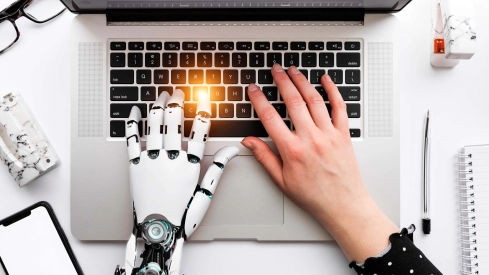
For years it has been repeated that artificial intelligence would cause a wave of layoffs and leave millions of workers out of the labor market. For now, data from the Spanish market does not paint that scenario. A report by Fedea and BBVA Research indicates that close to 30% of employment is exposed to generative AI and that, since 2022, occupations with greater exposure have increased their employment at a rate higher than the average.
The conclusion seems reassuring, but there is an important catch: the fact that jobs are not yet being destroyed does not mean that AI is not transforming employment or that it will benefit all workers equally. In fact, the more one looks at certain sectors, the more uncomfortable the picture becomes. Creative professions, precisely those that for decades have lived from writing, designing, illustrating, editing, translating, or producing original content, are among those that can most directly feel the pressure of these tools.
Employment holds up, but the profession is changing from within
The study estimates that some 7.2 million workers are in occupations with high exposure to AI and another 5.1 million in a medium-high exposure range. For now, researchers do not detect a negative relationship between this exposure and the total volume of employment. On the contrary: the most exposed occupations have grown since 2022.
But using that data to conclude that AI does not threaten certain jobs would be premature. A company can maintain the same number of employees while reducing the tasks it assigns to professionals, lowering production times, changing the profiles it seeks, or ceasing to hire workers it previously needed for certain functions. The position still exists on paper, but its content, its value, and even the possibilities of accessing it can be very different.
That is especially relevant in creative professions. A copywriter can continue to be employed while a part of their texts is automatically generated; a designer can remain on staff while a tool produces dozens of proposals in seconds; an illustrator can receive commissions while competing with artificially generated images; and a screenwriter can keep their job at the same time that the volume of human work needed to develop a project is reduced. The impact, therefore, does not always have to appear first as a wave of layoffs.
The paradox of jobs that AI can do and that are still growing
The Spanish data has another interesting reading. Occupations with greater exposure to AI are precisely those that concentrate a good part of qualified employment. More than 40% of workers with higher education perform high-exposure jobs, compared to around 15% among those with compulsory secondary education or lower education, according to the analysis collected by BBVA Research and Fedea.
This helps to explain why AI may be coexisting with more employment in these professions: the tools automate certain tasks, but do not necessarily suddenly replace the person who coordinates, supervises, or integrates them into a work process. The problem appears when this automation begins to affect the tasks that precisely constituted the most valuable part of a profession.
And here creative industries have a particular problem. Generative AI not only helps a journalist to research or a designer to accelerate a process: it can also directly produce text, images, music, video, or voices. The leap between using a tool as an assistant and turning it into a partial substitute for a creative task is much smaller than in other activities.
The blow may come sooner to young people and those trying to enter
The picture is also not the same for all generations. The report points to an especially high exposure among workers aged 25 to 34, while younger workers show lower levels of exposure in the analyzed occupations.
Here appears one of the most difficult risks to detect in general statistics: the entry point to the labor market. If a company can use AI to perform part of the work previously entrusted to junior profiles, it can keep its experienced professionals and reduce the need to incorporate new workers. The result does not have to be an immediate increase in unemployment; it can simply be that it becomes increasingly difficult to get a first job.
For creative professions, this scenario is especially relevant. The journalist who starts needs to publish to build a career; the designer needs commissions to form a portfolio; the illustrator needs clients to consolidate and the screenwriter needs opportunities to enter the industry. If the initial tasks are precisely the easiest to automate, AI can partially close the entry path even if the total employment in the sector continues to grow.
Culture is already demanding protection against AI
While employment data still does not show a massive destruction of jobs due to artificial intelligence, culture is already starring in one of the main conflicts around this technology. As reported by El País on September 29, artists and authors continue to denounce that their works, voices, and images can be used to develop AI systems without authorization or economic compensation. The Ministry of Culture itself recognizes the need to advance on issues such as express authorization, fair remuneration, and traceability of the works used.
The problem also does not stop at copyright. The Ministry of Labor is preparing a regulation to limit the reuse by AI of the voice and image of artists, so that these uses require agreement and remuneration. EFE detailed that same day that the proposal suggests that no creator can see their work replicated or used without a contract, express consent, and remuneration.
And Spain has already begun to prepare the labor ground for that change. Royal Decree 607/2026, published in the BOE in July, incorporates guarantees on intellectual property, image, and digital rights of artists and also establishes the creation of a commission to study transition and professional requalification programs in the face of new digital technologies, specifically including artificial intelligence.
The concern, moreover, is not exclusively Spanish. The European Commission opened a consultation on September 29 on the impact of technologies such as AI on copyright, including precisely the use of protected content to develop artificial intelligence systems and the remuneration of artists and performers. The debate, therefore, no longer revolves solely around how many jobs AI can destroy or create. In culture, something more basic is being discussed: who has the right to use a creator's work, under what conditions, and who should be paid when a machine learns from it.
That there is no employment crisis (yet) does not mean it will not arrive
The Fedea and BBVA Research report offers a snapshot of the labor market up to the second quarter of 2026, not a guarantee of what will happen over the next few years. Its own data show that Spain is incorporating workers into occupations highly exposed to AI, but this can coexist with a profound transformation of those same professions.
And here it is worth looking with special attention at those who live by creating. Because an artificial intelligence does not need to eliminate all journalists, designers, musicians, illustrators, or writers to radically change their professions. It is enough for it to make a part of their work unnecessary, for production to cost less, and for there to be more candidates competing for the assignments that survive.
AI has not yet caused the massive job destruction in Spain that many predicted. Current data say just the opposite. But to turn that data into a victory for artificial intelligence would be to confuse the number of jobs with the health of professions. And in creative ones, where the value lies precisely in what a machine intends to learn to reproduce, the battle has just begun.