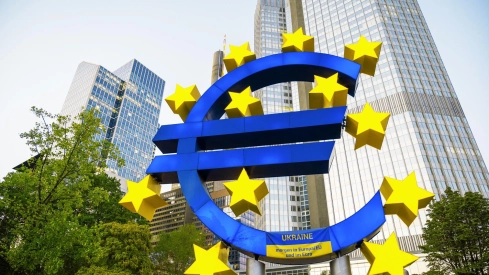
The digital euro has taken one of its most important steps this Thursday in Brussels. The European Parliament has backed the start of negotiations with the Member States to finalize the regulation that will govern this new form of electronic money issued by the European Central Bank. The vote passed with 416 votes in favor, 169 against, and 22 abstentions, despite the attempt to block it by the hard right and far-right European groups.
The initiative has a fairly clear political and economic objective. Europe wants to reduce its dependence on payment providers from outside the Union, especially on U.S. networks such as Visa, Mastercard, or American Express. The digital euro would not be a cryptocurrency nor an investment product. It would be public money in electronic format, backed by the ECB, intended for payments in shops, between individuals, or in digital services.
The negotiation will now begin with the Council, under the Irish presidency, and will be led by the Spanish MEP Fernando Navarrete Rojas, of the European People's Party. The timetable handled by the European institutions aims to close the legal framework before the end of the year. Afterwards, the ECB will have to complete tests, infrastructure, and technical development before deciding whether to finally issue the digital euro.
A European alternative to pay without always going through the US
The debate is not just about technology. It's about sovereignty. Today, a central part of electronic payments in Europe depends on companies, standards, and infrastructures that are not decided in the European Union. That dependence has become more visible with the geopolitical tension with the United States and with the return of Donald Trump to the White House, which has accelerated the discussion on strategic autonomy in Brussels.
The digital euro seeks to fill that gap without eliminating the private solutions already existing. In Spain, for example, Bizum has become an everyday system for transfers between individuals, but it does not function as a European public infrastructure nor does it have full reach throughout the eurozone. The idea in Brussels is that any citizen can have a digital option of central bank money, with European rules and European supervision.
The project also tries to protect itself from a common criticism. It does not intend to eliminate banknotes and coins. The package approved by the European Parliament includes a specific piece to reinforce cash, obliging eurozone countries to guarantee its availability and prevent shops from being able to prohibit it in a generalized way. That part is key for elderly people, citizens with low incomes, or users outside the traditional banking system.
How the digital euro would work
The digital euro would have two modalities. The online version would operate through a system of accounts and would allow digital payments similar to current ones, although with direct backing from the central bank. The offline version would work without an internet connection, through local storage on a device, with a logic closer to cash. If the user loses the device with offline money, they would also lose that balance, as happens with a physical wallet.
Basic services would be free for citizens. Opening an account, maintaining funds, managing them, and having at least one payment instrument would have no cost. Providers could charge for additional services, but Parliament wants to limit commissions and avoid practices such as penalties for inactivity or mandatory packages.
The majority of shops would have to accept payments in digital euros, although there would be exceptions for self-employed, small businesses, and microenterprises that do not already accept other digital payments. Banks, electronic money entities, post offices, and regulated payment service providers could also distribute it, even from EU countries that are not part of the eurozone.
Privacy, banking, and money limits
Privacy is one of the great battles of the digital euro. Parliament wants the system to incorporate guarantees from the design stage, with verifiable transactions without exposing personal data beyond what is strictly necessary. The approved position also states that the ECB should not have access to personal data that directly identifies the user.
The other major concern is in banking. If citizens could move large amounts of money from their bank deposits to digital euros, the financial system could suffer tensions. To avoid this, the regulation provides for a maximum holding limit per person. That figure has not yet been decided and will be one of the most delicate points of negotiation between institutions, ECB, Eurogroup, and the financial sector.
The digital euro would not generate interest either. It is not intended as a savings account or as a way to earn returns, but as a means of payment. Companies, moreover, could not accumulate it indefinitely. They could only keep payments for a limited period before settling them in their usual accounts.
The rejection of the far right and the phase that begins now
The Parliament's position did not go forward without resistance. Patriots for Europe, group in which Vox is, European Conservatives and Reformists and Europe of Sovereign Nations challenged the decision of the economic committee that opened the door to negotiations. Their attempt failed in the plenary and the Eurochamber maintained the mandate to sit down with the States.
From now the real negotiation begins. Parliament, Council, and Commission must finalize the definitive text, set the balance between privacy and security, define the role of banks, and ensure that cash remains available. The ECB, for its part, is already preparing a twelve-month pilot for the second half of 2027 and states that it wants to be ready for a possible first issuance during 2029, provided that the regulation is approved in 2026.
The digital euro will not arrive tomorrow in the pockets of Europeans. First it will have to overcome political negotiation, technical tests, and the final decision of the European Central Bank. The step taken this Thursday in Strasbourg leaves the project on the table of the States and opens the phase in which it will be decided whether Europe wants to pay digitally with its own infrastructure or continue depending on networks designed and governed outside the Union.
