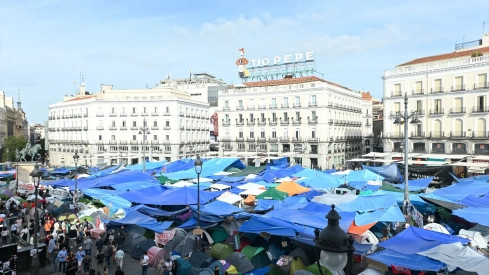
Madrid's Puerta del Sol has maintained since last Saturday an encampment called in protest of the housing situation. The mobilization arose after the attempted eviction of Maricarmen, an 87-year-old woman, and has grown in recent days to gather thousands of people and more than 1,200 tents. The protesters demand measures against the housing crisis and have decided to maintain the protest until they achieve commitments they consider sufficient.
The concentration has caused a political confrontation between the Madrid administrations and the Government Delegation. The Madrid City Council, led by José Luis Martínez-Almeida, and the Government of Isabel Díaz Ayuso have demanded the eviction of the square and have questioned whether the protest can be maintained for several days. The Government Delegation, for its part, maintains that as long as the concentration remains peaceful, the fundamental right of assembly must be respected.
Almeida's evidence, under scrutiny
The Unified Police Union (SUP) demanded this Wednesday from the Government delegate in Madrid, Francisco Martín, an “immediate” evaluation of the security situation in the encampment and that the necessary actions be determined to guarantee the safety of both citizens and agents. The request came after the City Council announced that it would transfer documentation to the Government Delegation and the Ministry of Interior about the alleged presence of cobblestones and large knives in the area: “If there are potentially dangerous objects in the encampment, the situation must be evaluated immediately”, stated the SUP, which asked the Government delegate to assess the risks and adopt the measures he deems necessary.
However, part of the evidence used by the City Council to question the security of the encampment has raised doubts about the scope of its accusations. Among the images disseminated by the City Council appears, for example, a knife next to bread and hummus, while the campers have explained that some of the indicated cobblestones are used as counterweights for the tent structures. So far, the information published about the protest does not point to serious incidents.
The SUP's request is, therefore, parallel to the accusations made by the City Council, but it does not in itself constitute a confirmation that serious incidents have occurred or that the indicated objects pose a proven risk. The matter was pending a security evaluation by the competent authorities.
Firefighters rule out danger in Sol
The Madrid City Council Fire Department inspected this Wednesday the Puerta del Sol to check if the arrangement of the more than 1,200 tents could hinder their intervention in the event of a possible emergency. The report, prepared at 10:50 a.m. on September 30 at the request of the General Directorate of Firefighters, concludes that the existing occupation at that time "does not significantly affect the access conditions for Fire Department vehicles."
The personnel carried out a visual inspection of all accesses to the square and the main fire protection elements. They verified that the entrances through Alcalá, Montera, Carmen, Preciados, Arenal, Mayor, and Carretas remained free of tents or other camping elements that could impede the passage of emergency vehicles. In addition, they also verified that the dry column of the Renfe facilities located in Puerta del Sol was completely clear, as were the hydrants on Carmen and Arenal streets. Furthermore, they pointed out that the distribution of the tents maintains the main access routes and allows the circulation of emergency vehicles around the perimeter of the square.
The report thus leaves the Madrid City Council facing an evident contradiction between Almeida's political discourse and the checks carried out by its own emergency services. The inspection does not determine that the encampment should be maintained nor does it resolve the political conflict, but it does dismantle one of the main arguments used by the City Council to present the occupation of Sol as a problem for the Fire Department's actions.
