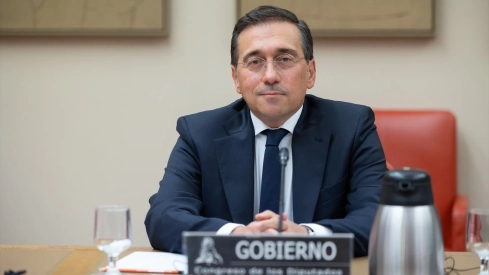
The Government of Spain faces new explanations this Friday regarding the actions of the different ministries in response to the Ceuta crisis after the massive entry of people into the autonomous city at the end of July. The Minister of Interior, Fernando Grande-Marlaska, the Minister of Foreign Affairs, José Manuel Albares, and the Minister of Inclusion, Social Security and Migration, Elma Saiz, appear in the Congress of Deputies at their own request to detail the response of their respective departments. Albares was the second to speak and focused a good part of his appearance on the relationship with Morocco and the defense of Spanish sovereignty over Ceuta and Melilla.
The Minister of Foreign Affairs made it clear that the sovereignty of both autonomous cities is not part of any negotiation with Rabat. Albares assured that “there has been, there is, and there will never be any kind of conversation about it” with Morocco and stressed that Spain has responded through “all available diplomatic channels” to statements it considers contrary to its territorial integrity.
In his speech before the Foreign Affairs Committee, the minister also asserted the Spanish and European character of the two cities. “Ceuta and Melilla are Spain and are the European Union, they are part of our territorial integrity and our sovereignty,” he affirmed. Albares extended this consideration to all their inhabitants, regardless of their origin or beliefs, whom he defined as “Spanish and European not only by right, but by heart and soul.” “And it will always be so,” he declared.
Despite this position, Albares defended the need to keep communication channels open with Morocco. The minister considers diplomatic dialogue to be “indispensable” due to its status as a neighboring country and the particular situation of the borders of Ceuta and Melilla. In this regard, he explained that communication between both countries is maintained permanently with the aim of containing the crisis and preventing a similar situation from recurring in the future.
Social media, at the origin of the massive arrival
The minister identified disinformation spread through social media as the “immediate trigger” for the massive entries recorded on July 30 and 31. According to his explanation, various messages would have distorted the content of a Supreme Court ruling related to arrivals by swimming, generating a pull factor.
Albares has framed this phenomenon within a broader structural reality: the enormous inequality existing on both sides of the borders of Ceuta and Melilla. He has defined these borders as “the most unequal” and possibly “the most complex on the planet,” due to the differences between Europe and Africa and the existing violence in certain areas of the African continent. For this reason, he has warned that migratory movements will continue to constitute one of the great challenges in the coming years.
In this context, he has also focused on the role of digital platforms. Albares has reported that on August 7, the European Commission held a meeting with Meta and TikTok to expedite the work of accredited verifiers and address the spread of false content.
The minister has considered that the crisis cannot be analyzed solely from the migratory point of view, but also from the battle for the narrative on social networks. “What began as a migratory crisis caused by falsehoods, has also been a battle of ultraconservative and reactionary narratives,” he said, before pointing to the difficulties posed by the moderation of large digital platforms.
Albares explained that in Morocco and other North African countries, content circulated related both to the July 30 call and to the subsequent, ultimately failed, August 15 call, and highlighted the role played by various influencers in disseminating these messages.
The minister also cited internationally far-reaching profiles such as Elon Musk, whom he placed among those who contributed to amplifying certain publications on July 30 and 31. In his opinion, the images disseminated about the events ended up functioning as “electoral gasoline for the far right.” Albares has maintained that the objective of this content was not only to inform, but to spread “the narrative of a security collapse and the denunciation of a civilizational threat.”
Albares demands solidarity from Italy and Denmark
During his appearance, the head of Foreign Affairs also directed his criticism towards some European partners for the response offered during the crisis. Albares lamented the lack of solidarity from Italy and Denmark and recalled that Spain has provided support to other European countries when they have faced similar situations, citing the Spanish response during the Lampedusa crisis as an example.
“Europe is solidarity and without solidarity there is no Europe,” said the minister, who urged both countries to understand the need to act in a coordinated manner in such situations.
He was particularly critical of Italy's decision to establish controls on travelers from Spain without prior consultation. Albares described this measure as “arbitrary” and linked it to “reasons of internal electoral politics.”
In his opinion, the Italian decision constituted “an unjustified and unjustifiable affront to the dignity of Spaniards and to the unity of the European Union,” at a time when, he argued, the response to the Ceuta crisis precisely required greater coordination and solidarity among member states.
Add ElConstitucional.es as a preferred Google source for free.
Stay informed about all the latest breaking news with the best information. Against disinformation, for democracy and social rights.
