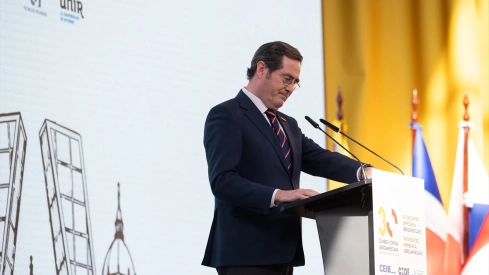
The president of the Spanish Confederation of Business Organizations (CEOE), Antonio Garamendi, on Wednesday criticized the Government for supporting and promoting the general strike day, which he defined as an "official", "atypical" and "preventive" call, and warned that they will demand accountability if the situation "gets out of hand".
In statements to Antena 3, Garamendi criticized members of the Executive for having encouraged the protest and pointed directly to the second vice president and two ministers present in Moncloa. "From the Government, the second vice president has been urging the strike and yesterday, in Moncloa, two ministers were encouraging the strike. A strike against whom? That is the question," questioned the president of the CEOE.
The business leader also stressed that the Government has responsibility in matters such as housing or public services, because "it has been governing for eight years", and insisted that the call does not respond to a usual situation in Spanish democracy.
"The first time we see this story"
For Garamendi, the context of this strike is unprecedented in recent democratic history. "We have had 50 years of democracy, it is the first time we are seeing this story, the first time I think almost in the world, that there is a preventive strike," he said when asked if the general strike represents the last service of the unions to the Government of Pedro Sánchez.
The president of the employers' association defended that discrepancies should be resolved through social dialogue and criticized resorting to the streets when electoral results are not favorable. "Hey, the ballot boxes are what rule, and if I don't like the ballot boxes I go to the street... Man, I don't think this is very democratic," he said.
The follow-up, according to Red Eléctrica data
As a reference to measure the real scope of the strike, Garamendi cited the figures from Red Eléctrica, according to which the drop in energy consumption between 9:00 and 11:00 hours was 6%, a percentage that he placed far from other general strikes. "Normally in the 2014 strike it was around 15%," he explained.
Likewise, he indicated that during the night the energy drop, which reflects the activity of large industry, was limited to 2.5%.
Uneven impact by sectors and territories
The president of the CEOE specified that the follow-up is more clearly seen in factories, where there is a greater union presence, while among self-employed workers "there is practically no incidence". He also maintained that small businesses have remained open normally, as is the case, he said, in the vast majority of Spanish municipalities.
"In 8,000 towns that we have in Spain there is no incidence," Garamendi affirmed, comparing the behavior of the strike between rural areas and large cities.
Gran Vía of Madrid and the role of pickets
In relation to urban commercial arteries, Garamendi gave the example of Gran Vía in Madrid, where he pointed out that "everything was open", and warned of the effect that informative pickets can have if they force business closures. "There is the right not to go to work, but there is the right to work," he stressed.
In subsequent statements to esRadio collected by Europa Press, he insisted that if the shops on Gran Vía had closed, it was not of their own free will, but due to the action of the pickets and the demonstration that runs through the area. "I don't think they were convinced in a very calm way (to close)," he said.
An "incomprehensible political strike"
Garamendi elaborated on his criticisms and described the call as an "incomprehensible political strike, in many cases called by the Government", while considering that the protest "did not have all the success it intended".
The leader of the employers' association recalled that the initial promoter of the strike, the Tenants' Union, is an association, and questioned the role of traditional trade unions in this mobilization. "What has happened is that the class unions with whom I have to work, well, what they have done is to find the formulas to give legal coverage (to the strike). I think it's a mistake," he said.
Call for calm and freedom of movement
Finally, the president of the CEOE demanded "that there be no violence in the streets" and that citizens be able to move freely, warning that "many people do not go to the street because they are indeed afraid that something they don't like might happen".
Contact