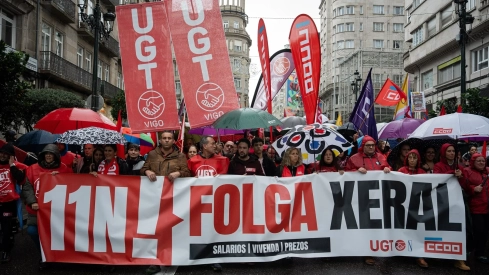
The call for a general strike for this Wednesday, November 11, in Spain has raised a series of questions about the scope of the right to strike, the functioning of minimum services, and the labor consequences for those who decide to support it. The mobilization has been registered by Comisiones Obreras (CCOO), Unión General de Trabajadores (UGT), along with CGT, CNT, Unión de Actores y Actrices, CO.BAS, la Intersindical, and the Confederación de Sindicatos de Inquilinas.
All workers, from all productive sectors and labor areas, are called to participate in the strike, with one specific exception: Ceuta, whose workers have been excluded from the call due to the anomalous situation that the autonomous city is still experiencing as a result of the migratory crisis.
The company cannot sanction for exercising a fundamental right
Participation in a general strike constitutes the exercise of a fundamental right, so the company cannot sanction, dismiss, or retaliate against a worker solely for supporting it. The exercise of the right, in this case, is protected and cannot become a reason for labor punishment.
What discount is applied to the payroll
Supporting the strike has economic consequences. As Legálitas reminds, the worker will have the part corresponding to the non-worked day deducted from their payroll, both from the base salary and from supplements and bonuses, in addition to the proportional part of the extra payments when the time comes for their calculation.
Participation also affects contributions, as the striking worker enters a special situation in Social Security, with no obligation to contribute during that period.
It is not mandatory to notify the company before striking
Workers are not obliged to notify their companies in advance if they intend to support the strike, nor do they have to justify the reasons why they decide to participate. It is enough to exercise that right during the called day.
This protection also extends to questions that company managers may ask. If a boss asks an employee if they plan to come to work, the employee is not obliged to reveal their decision. The company also cannot use questions, pressure, or threats to try to dissuade staff from participating in the mobilization.
Therefore, expressions such as "I need to know if you are coming" or warnings about possible subsequent consequences cannot become intimidation mechanisms. The right to strike is individual and its exercise does not depend on communicating the decision to the company in advance.
When minimum services apply
Minimum services are only applicable when the strike affects essential services for the community, whether they are public or private companies. Their establishment corresponds to the competent governmental authority, which sets them through a resolution.
When an activity is essential, the company can nominally designate the employees who must fulfill these minimum services, and the designated workers are legally obliged to go to their post and perform the assigned tasks.
What happens if a worker arrives late or cannot access
If, as a result of the strike, a worker arrives late or cannot access their workplace, they must quickly communicate the incident to the company. As far as possible, the company must offer teleworking to those who want to exercise their right to work or facilitate the recovery of that day.
Can teleworking employees strike?
Employees who work from home also have the right to support the general strike. The fact that they carry out their activity remotely does not limit or modify their right to participate in the mobilization, as the strike implies ceasing to provide services during the called period, regardless of the place from which they work.
In this way, those who decide to join the strike will not have to connect to their work platforms, answer professional calls, respond to emails, or perform tasks related to their position during the strike day.
The company cannot threaten or retaliate against strikers
The legitimate exercise of the right to strike cannot become a reason for dismissal, sanction, or worsening of working conditions. Companies also cannot use warnings about possible future consequences to try to prevent their employees from participating in the call.
In case of receiving threats, pressure, or intimidating communications, workers can keep messages, emails, and any other evidence that allows proving what happened. They can also report possible retaliation if, after supporting the strike, they suffer detrimental changes in their working conditions or disciplinary measures related to their participation.
Overtime cannot be worked, nor can strikers be replaced
During the strike day, overtime cannot be worked, nor can workers who support it be replaced, nor can tasks corresponding to a person who has decided to participate in the strike be assumed.
The demands of the unions
The convening organizations demand from public authorities measures to guarantee access to decent and adequate housing and, at the same time, ask that workers recover purchasing power through increased wages. In addition, they demand that employers sit down to negotiate a new wage framework that allows them to cope with the rising cost of living.
Contact