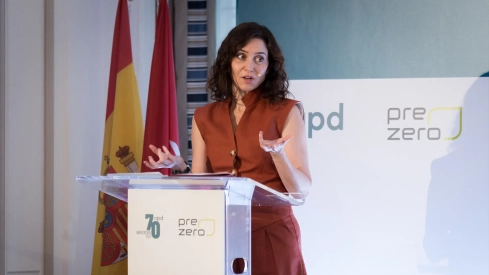
The president of the Community of Madrid, Isabel Díaz Ayuso, this Monday placed the granting of Spanish nationality at the center of the debate by warning that officials and consuls could be acting “illegally” if they grant it to people “who do not deserve it.”
During a breakfast colloquium organized by the Association for the Progress of Management, the regional leader directed her criticism at the regulatory framework linked to the Democratic Memory Law, stating that “there is no Grandchildren’s Law that hides the fact that Spain needs to restart.” Ayuso linked mass regularizations with what she defined as a possible “pull factor” and warned of consequences for public services, speaking of an eventual “collapse of the public system” if these policies continue.
The Madrid president extended her criticism to the electoral sphere, stating that the third province in number of votes in future elections “will be Argentina,” in reference to the external vote, and questioned the management of the census and its possible impact on parliamentary representation. In that vein, she maintained that any use of the consular or administrative system to influence the distribution of seats would be “illegal,” directly pointing to the Government in the management of the electoral system. "The Government cannot have the power to assign provinces arbitrarily according to the vote count, according to where it lacks the necessary votes to obtain the next seat."
Likewise, she defended a restrictive view of the exercise of politics, insisting that public offices are temporary and that only those who maintain “good ideas and purposes” should continue.
Ayuso and her previous attempt to stop regularization
The Community of Madrid and Vox had already appealed before the Supreme Court the decree for the extraordinary regularization of migrant people, requesting its urgent suspension while the merits of the matter were resolved. The appellants then argued that the measure could have a significant impact on the provision of public services such as health, education, or housing, by foreseeing the incorporation of hundreds of thousands of people into the administrative system.
The Administrative Litigation Chamber of the high court held visits to analyze these petitions, in which the parties' arguments were heard before adopting a decision on the precautionary measures. Finally, the Supreme Court rejected the requested suspension, considering that the risk of collapse of public services or the existence of irreversible damages derived from the immediate application of the decree had not been sufficiently accredited, so the regularization continued its course.
Add ElConstitucional.es as a preferred Google source for free.
Stay informed about all the latest breaking news with the best information. Against disinformation, for democracy and social rights.
