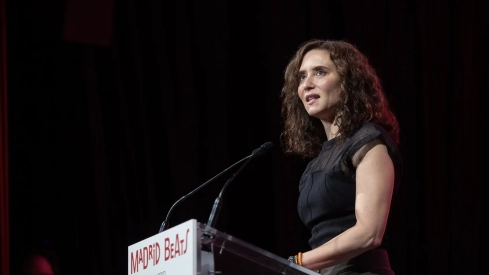
The president of the Community of Madrid, Isabel Díaz Ayuso, has opted for a direct confrontation with the Government in the battle for new regional financing. Madrid will not attend this Friday's Fiscal and Financial Policy Council (CPFF), convened by the Minister of Finance, Arcadi España, to address and vote on the system reform. The Madrid Executive had also called on the rest of the communities governed by the PP to support the boycott with the aim of preventing the body from being constituted due to lack of quorum. However, no other popular autonomy has finally followed Ayuso's strategy.
The maneuver by the Madrid president sought to stop the reform's progress from within the Council itself. According to the CPFF regulations, for the meeting to be validly constituted, it must have the attendance of at least half of its members. Ayuso's Government communicated its absence and tried to convince the rest of the PP's regional executives to do the same, but the other territories have chosen to attend and express their rejection of the model there.
Ayuso tries to turn financing into another front against Sánchez
The Madrid Executive maintains that the proposal breaks equality among Spaniards and questions that the new system has its origin in the negotiations held between the central Government and Catalonia. Madrid has also criticized what it considers privileged treatment for the Generalitat and has defined the reform as a "whitewashing of the economic and political corruption of the managers of the Generalitat of Catalonia in recent decades."
Ayuso's strategy has not, however, managed to drag the rest of the popular communities into the boycott. The PP's regional governments will attend the Council to vote against the proposal, so Madrid is isolated in its decision not to participate in the meeting. Catalonia and the Canary Islands are the autonomies that have announced their support for the model proposed by the Treasury.
Treasury defends a reform with more resources
Faced with the rejection of a good part of the communities, the Government maintains that its proposal will allow increasing the resources available for the autonomies by almost 21,000 million euros and reducing the financing differences between territories. Arcadi España himself has urged the communities to face the vote and has summarized the debate as a choice between a system that provides more resources and one that maintains current inequalities.
"Excuses are no longer valid. It is time to decide whether we bet on a model that provides more resources and reduces financing differences between territories or not. This is the question we must answer," said the minister.
The proposal also entails an increase in the participation of the communities in certain taxes. The new model raises the transfer of IRPF to 55% and VAT to 56.5%, compared to the current 50%, while introducing modifications in the criteria used to calculate financing needs, including a new definition of adjusted population.
The rejection of the model will not prevent it from moving forward
Friday's scenario does not, in any case, imply the definitive approval of the new system. The CPFF constitutes a preliminary step within a process that must subsequently continue in the Council of Ministers and in the Congress of Deputies, where the reform will have to pass its corresponding parliamentary procedure. The Government maintains the objective that the new model comes into force on January 1, 2027.
The vote thus reflects a particularly complicated picture for the Treasury: most communities reject the proposal, while the Government has the necessary support to advance in this phase. The absence of Madrid has not managed to paralyze the procedure and leaves Ayuso facing a new political battle in which her blocking strategy has not found the territorial support she sought.