José María Aznar has questioned the sympathy that part of the European right shows towards Vladimir Putin, president of Russia and political ally of some formations close to the far-right party, Vox. During the delivery of the XIII FAES Foundation Freedom Awards, which Aznar himself presides, the former President of the Government has criticized that certain conservative sectors see in the Russian leader a reference for traditional values.
"The sympathy of a certain European right towards Putin's regime is surprising. It seems as if they see in him a vigorous expression of traditional virtues. Abysmal confusion. Putin is an autocrat," he stated. With these words, Aznar has questioned the image that, in his opinion, some sectors of the European right have of the Russian leader, whom he has defined as an authoritarian ruler.
Aznar criticizes the European right for its stance on Putin
The former president has also rejected that the Kremlin's discourse against the West could be attractive to European conservative parties. "It is absurd that his rhetoric about Western decadence seduces anyone," he pointed out during the event, in which he questioned whether Russia could represent the values defended by part of the right.
Aznar has justified his criticisms by recalling the country's Soviet past and its historical confrontation with Western values. In his speech, he described Russia as a State marked by the legacy of a system that, according to his words, was "hostile in principle to any recognizable form of morality."
The former president's statements highlight the differences within the European right regarding Putin. Although Aznar has criticized the sectors that sympathize with the Russian leader, his words have been directed at "a certain European right" and do not constitute, by themselves, a direct accusation against Vox. The reference to the party is framed within its political ties with European formations that maintain positions favorable to the Kremlin.
Iran and Cuba, also at the center of his criticisms
Aznar has also attacked sectors of the left for the positions that, in his opinion, they maintain regarding the Iranian regime. The former president has described as "irresponsible, hypocritical and radically mistaken" the attitudes he considers favorable to the authorities of Iran, especially in the face of the "extreme violence" used to repress protests in Tehran and other areas of the country.
Regarding Cuba, he has criticized those who, according to him, have supported the dictatorship and now downplay the island's political situation. Aznar has stated that the Cuban government has not presented "any sincere proposal for democratic transition" and has summarized his position with a forceful phrase: "Castroism proposes a suicidal dilemma: its perpetuation or collective collapse".
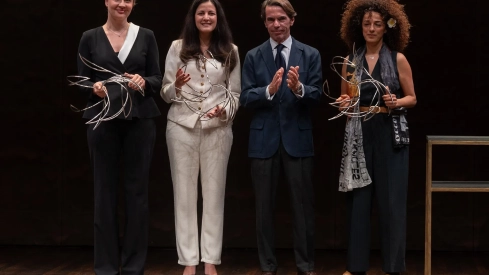
The former president delivered these words during the XIII FAES Freedom Awards, which have recognized three women who defend rights and freedoms in authoritarian contexts: Yulia Navalnaya, widow of Russian opposition leader Alexei Navalny; Rosa María Payá, promoter of Cuba Decide and daughter of Cuban dissident Oswaldo Payá; and Masih Alinejad, Iranian activist. During the event, Aznar also criticized what he called the "fake feminism" of the "domestic progressives", whom he reproached for, in his opinion, keeping the three award winners invisible.
