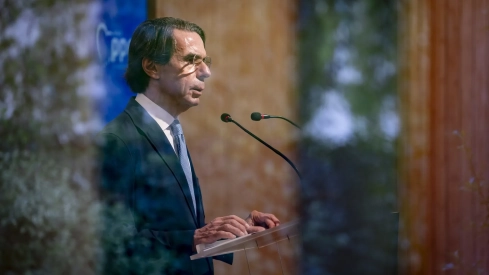
José María Aznar has turned the announcement of general elections for November 29 into a warning about the supposed end of the monarchy and the unity of Spain. The former President of the Government and of the Popular Party (PP) assured this Monday in Seville that, if Pedro Sánchez manages to form a new Executive with his current allies, the known constitutional system will disappear. He also accused the PSOE of being capable of altering the census to obtain electoral advantages, without providing evidence of manipulation in his speech.
The current president of the FAES Foundation participated in a dialogue with journalist Juanma Lamet within the 'Letras en Sevilla' cycle, organized by the Cajasol Foundation and dedicated this year to the Civil War. Just a few hours after the early election announcement, Aznar presented the elections as "the most important since the beginning of the transition" and attributed to Sánchez and his allies the intention of giving them a "practically constituent" character.
"If the current governing coalition were to win the elections, were able to form a government again, it is evident that the constitutional system we have known until now, the unity we have known until now, and the parliamentary constitutional monarchy we have known until now, will end," he stated, according to Europa Press. Asked directly if that result would lead to a republic, he replied "Absolutely, that is not hidden."
Aznar thus placed an eventual progressive majority outside the institutional normality that involves forming a Government after elections. He accused Sánchez's partners of acting against the Constitution and linked their defense of plurinationality with the "overthrow" of the Crown. His intervention presents as a consequence of an investiture a change of regime that would require a specific constitutional procedure.
The Constitution establishes in its article 1.3 that the political form of the State is a parliamentary monarchy. Modifying it requires resorting to the reinforced procedure of article 168, with two-thirds majorities in the Congress and the Senate, dissolution of the Cortes and new elections. The resulting Chambers would have to ratify the decision and approve the new text also by two-thirds before submitting it to a referendum. Winning the general elections or gathering support for an investiture does not by itself allow for the abolition of the monarchy.
The former president has extended that alarmist discourse to the electoral roll. He has defended caution regarding the so-called 'grandchildren's law', which allows descendants of Spaniards to access Spanish nationality, and has questioned whether people who have never lived in Spain can vote. "If they ask me if I believe they are capable of altering the electoral roll to seek certain advantages, the answer is yes," he maintained. He added that whoever did it "in their home, in their party" would be capable of doing it "in everyone's home."
The vote of those naturalized by this means is also subject to judicial controversy. The Supreme Court agreed on September 8 to a precautionary suspension, and its application to the November 29 electoral roll remains pending, according to RTVE. This dispute over who can vote does not substantiate the accusation of fraud that Aznar projects onto the PSOE. The former president has mixed his rejection of the extension of the right to vote with the suspicion that Sánchez might use the electoral roll for his own benefit.
His words add to the doubts raised today by the president of the Community of Madrid, Isabel Díaz Ayuso, and the leader of the far-right Vox, Santiago Abascal, about the electoral process. The PSOE has demanded that Alberto Núñez Feijóo disavow this questioning. The President of the Government, for his part, has called for elections after the defeat of the housing decrees and has called to choose between maintaining a progressive executive or joining the "far-right wave."
He despises the strike and fears a strong Vox
The housing crisis and the union response have also occupied part of the intervention. Aznar has ridiculed the agreement between Comisiones Obreras (CCOO) and the Unión General de Trabajadores (UGT) to call a general strike of 24 hours this autumn. "It would be the first time a strike is called against the opposition, against the alternative," he stated with a laugh, before calling that possibility "something politically delirious."
The objectives announced by the unions contradict that description. The unions demand sufficient wages to access decent housing and appeal to administrations with housing competencies and business organizations responsible for collective bargaining. The date will be agreed upon with social movements and the Tenants' Union, and the call must be ratified by the highest governing bodies of both unions.
Aznar has also attacked the measures on rentals with the argument that landlords are "criminalized". He has defended freeing up land, building social housing, and facilitating youth employment. His reading shifts the protest over prices and wages towards an alleged attack on landlords and the PP, on a day when unions have precisely placed the relationship between labor income and housing costs at the center of their mobilization.
When speaking of a possible arrival of Feijóo at La Moncloa, the former president has called for a "deep national reconstruction agenda", although he has acknowledged that the weight of Vox could complicate it. He has compared a scenario of 140 PP deputies and 60 Vox deputies with another in which the popular party obtains a much greater advantage. Regarding the first formula, he has admitted that he is not clear that it would allow addressing the country's problems.
Aznar's reservation focuses on how much decision-making capacity the far-right would have within a coalition. He has not ruled out an agreement with Abascal, who today demanded "national priority", "deregulation" and "remigration" as conditions for a future Government with the PP. While warning of the risk he attributes to Sánchez's allies, the former president contemplates the alternative of Feijóo with Vox depending on the distribution of seats.
Aznar has also blamed Sánchez for the growth of the far-right party. "The great dream of whoever called the elections is to do the greatest possible harm to the PP and, therefore, the greatest possible favor to Vox," he stated. His intervention comes in a forum coordinated by Arturo Pérez-Reverte and Jesús Vigorra that was postponed after the withdrawal of several participants, including David Uclés, and which resumed its sessions this Monday in Seville.
