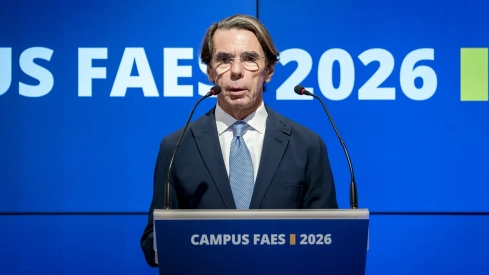
José María Aznar has turned this Wednesday's inauguration of the FAES Campus 2026 into an extensive amendment to Pedro Sánchez's eight years in La Moncloa. The former President of the Government has accused the Executive of deteriorating Spain on economic, territorial, and institutional levels and has raised his tone to warn about the risks that, in his opinion, the last stage of the legislature entails.
"I said back then that terminal Sanchismo was a singularly dangerous Sanchismo. And we are seeing it," he stated during the event held in Madrid. Aznar described a paralyzed country and a Government "incapable of any effort other than propaganda," which he presents as a "story factory" dedicated to preparing the electoral ground.
The speech had little to do with the title chosen for this edition of the campus, Latin America in transformation and its consequences for the European Union. The president of the Foundation for Analysis and Social Studies (FAES) dedicated most of his intervention to Spanish politics, although he also accused the Government of conditioning its relations with Ibero-America according to the political orientation of each country.
In the economic field, Aznar has assured that Sánchez's legacy leaves less purchasing power, more taxes, more waste, and greater debt. He also spoke of a "galloping deterioration" of railways, airports, and hydraulic infrastructures, within a general description of Spain as a "broken" country.
His criticism extended to the use of institutions and to the corruption cases surrounding the PSOE. Aznar accused the Executive of practicing an "authentic privatization of the State" through the colonization of public bodies and the parliamentary agreements that allowed Sánchez's investitures. The former president placed pardons, the amnesty law, and pacts with independentist parties in the same block.
His argument ignored that the Court of Justice of the European Union (CJEU) has recently endorsed the compatibility of the amnesty with Community law and has recognized that the norm seeks to reduce political tensions in Catalonia. It also overlooks that Aznar himself came to La Moncloa in 1996 through agreements with Convergència i Unió and the Basque Nationalist Party that included important transfers of powers.
Aznar has directly blamed Sánchez's "normalization" and "appeasement" strategy for the rise of Aliança Catalana, the far-right pro-independence party led by Sílvia Orriols. "Normalization and reunion are today called Aliança Catalana," he declared before predicting a Parliament "dominated by the most xenophobic version of separatism."
Polls do reflect strong growth for Orriols' party. A recent Sigma Dos survey attributes 16.7% of the votes and between 25 and 28 seats to it, a rise that could place it as the second force in Catalonia. Linking this ascent exclusively to the Government's territorial policy, without considering the desgaste of Junts, immigration, or the crisis of public services, is part of Aznar's political diagnosis.
The former president has applied the same approach to the Basque Country and has accused the Government of "emptying prisons of terrorists" and filling institutions with their "frontmen." His intervention comes as EH Bildu disputes the first electoral position with the Basque Nationalist Party. ETA definitively abandoned armed activity in 2011 and announced its dissolution in 2018, while the transfers and progressions of grade of its prisoners are applied within penitentiary legislation.
Aznar has also brought up the Ceuta crisis to attack Sánchez. He has accused the Executive of "betraying commitments" on the Sahara and of neglecting border control, in addition to reproaching the president for keeping his summer vacation "intact" while Ceuta residents faced the consequences of the massive entry at the end of July. The Government has admitted that the Moroccan device failed, has demanded answers from Rabat, and has reinforced surveillance in Ceuta and Melilla in recent hours.
Another of his harshest accusations has pointed to the so-called 'grandchildren's law'. Aznar has spoken of an "attempt to distort the electoral census" due to the registration of descendants of exiles who have acquired Spanish nationality. The Supreme Court has provisionally suspended the electoral effects of a part of these registrations until consulates verify compliance with the requirements. The resolution is still provisional and also does not prove the existence of electoral fraud organized by the Government.
Useful vote for the PP and warning to the far-right Vox
The speech has also included a message for the space located to the right of the Popular Party. Aznar has asked to concentrate the vote on the acronyms led by Alberto Núñez Feijóo as "the shortest path" to build a strong Government and do "the opposite of Sanchismo". "Something very different from practicing Sanchismo in reverse," he clarified.
The warning points towards the far-right Vox, although the former president has avoided naming it directly. Aznar has criticized the "essentialism of a certain right" and has warned that the polarization strategy can fuel populist options with little government experience. His proposal is for the PP to present itself as a national and inclusive alternative to parties that bet on prolonging confrontation.
This call to reduce division has coexisted with expressions such as "terminal Sanchismo", "damaged Spain" or "historical setback". Aznar has argued that the next general elections should become "a great national call" to cancel Sánchez's stage and grant the PP a mandate for political, economic and institutional reconstruction.
The FAES Campus will continue until this Friday, when Feijóo will be in charge of closing it. The president of the PP will then take over a speech that demands centrality, useful vote and distance from the far-right Vox while hardening the offensive against Sánchez.
Add ElConstitucional.es as a preferred Google source for free.
Stay informed about all the latest breaking news with the best information. Against disinformation, for democracy and social rights.
