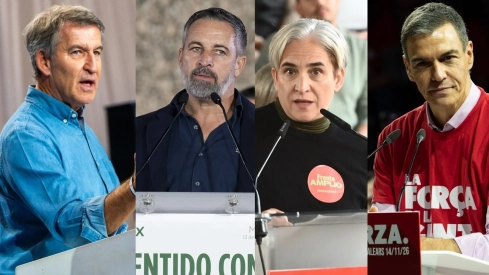
The pre-electoral macro-survey by the Center for Sociological Research (CIS), published in recent days, places two factors at the center of the 29N campaign: electoral mobilization and the ability to convince those who have not yet decided their vote. 83.1% of respondents say they will go to the polls "with absolute certainty," although among young people aged 18 to 24, this percentage drops to 70%, compared to 89% of voters aged between 65 and 74. In addition, 1.6 million citizens will be able to vote for the first time in a general election.
The participation figures from recent elections, however, invite caution when taking these forecasts. In the general elections of July 2023, 70.4% of the electoral roll voted —4.2 points more than in the November 2019 elections— a figure lower than the high predisposition now reflected in the survey. It remains to be seen whether, on November 29, this intention finally translates into greater mobilization.
The socialist candidate, Pedro Sánchez, this weekend called for a massive mobilization of the progressive electorate to win the next general elections: "They have too many workers' rights, that's why we have to go vote on 29N," he pointed out.
Sánchez's campaign team is confident of a "massive mobilization" that will allow four more years of government and predict that the participation percentage of the last elections will be exceeded. The strategy is to turn the election into a choice between two political models and prevent part of their electorate from staying home.
The polls, moreover, are starting to give them some breathing room. The latest 40dB tracking for EL PAÍS and Cadena SER places the socialists above 30% for the first time since the 2023 elections. An advance that, however, barely alters the arithmetic of governability: the right continues to add a majority exceeding 190 seats.
But does greater participation necessarily benefit the left? Electoral history offers arguments to support that high mobilization has coincided on several occasions with socialist victories, although it does not allow for an automatic relationship to be established.
The PSOE won with turnouts of 79.9% in 1982, 76.4% in 1993, and 75.6% in 2004. However, it also achieved victory in 1989 with a turnout of 69.7%. And in 1996, with a 77.3% turnout, it was José María Aznar's PP that prevailed.
Mobilization matters, but the result also depends on who manages to activate their voters.
In Alberto Núñez Feijóo's campaign team, they are confident of surpassing the 30% vote barrier and snatching some seats from VOX in what remains of the campaign. Their goal is to consolidate the leadership of the right-wing bloc and prevent the growth of Santiago Abascal's party from further conditioning the distribution of seats.
When asked about the polls published in recent days, Génova prefers to refer to its internal measurements, which, they assure, offer them an "unquestionable victory."
From VOX, they do believe that the predictions that bring them close to the 20% vote barrier will be fulfilled. For Santiago Abascal's team, any result close to the estimates of most pollsters will be "a historic victory."
In the most optimistic scenario, and with the remaining campaign days ahead, they do not rule out even improving that percentage, a scenario that, they acknowledge, would allow them to face an eventual post-electoral negotiation from a stronger position.
For her part, Ada Colau's team, candidate for the Broad Front, insists that the polls "are on the rise." They have set a goal of reaching 10% of voting intention and fighting in about fifteen provinces to snatch seats from the right, especially VOX, which could be decisive in the composition of Congress. All this despite the fact that the main polls point to a notable setback for the alternative left space.
For now, projections give them two seats in Madrid, Colau's own in Barcelona, and the one guaranteed to them in Valencia by the Compromís-Front Valencià coalition. The rest of the seats remain up in the air.
Podemos, which became the third political force in 2015 with 69 seats, is fighting this time to maintain its presence in Congress with a single seat for Madrid, that of Irene Montero. The party is confident that its bases "will support them" to be "decisive" in a future progressive coalition government.
Targeting young voters (and the undecided)
The first stages of the electoral campaign have been marked by interviews with candidates on Jordi Wild's YouTube channel, a new communication window that a good part of the political parties—with VOX as an exception—have used to approach young voters and seek spaces for dialogue away from traditional political formats.
The participation gap with older voters, already noted, makes this segment one of the main targets of the campaign. Electoral teams know that part of the success of their strategies involves attracting this young electorate, not only because of their ability to sway certain results, but also because it is a segment less prone to having their vote decided so far in advance.
Among the candidates' teams, there is unanimity that they must concentrate efforts on involving a generation that gets its information, and therefore also decides its vote, through new communication channels. Social networks, digital channels, and entertainment formats have become arenas of political dispute. It is no longer enough to wait for voters at rallies or in traditional media interviews: parties go out to find them where they consume information.
But the battle is not limited to young people. The CIS itself points out that 49.1% of respondents decide their vote based on what convinces them most at that moment, including the possibility of not voting. This is a very high percentage that reflects the fragility of electoral loyalties and explains why candidates multiply interviews, appearances, and events to make the most of the last days of the campaign.
The dispute of 29N therefore has two dimensions. One involves mobilizing those who have already decided their vote; the other, convincing those who still doubt or even contemplate abstention. The PP and PSOE need to consolidate their respective blocs to fight for around 30%; VOX aspires to approach 20% and the Frente Amplio seeks to reach 10% to maintain parliamentary influence.
In this scenario, the youth vote and that of the undecided can become more than an added factor: they can be the variable that ultimately tips the balance. Polls paint a picture, but there is still a campaign to be fought and, above all, millions of ballots to be decided.
Contact