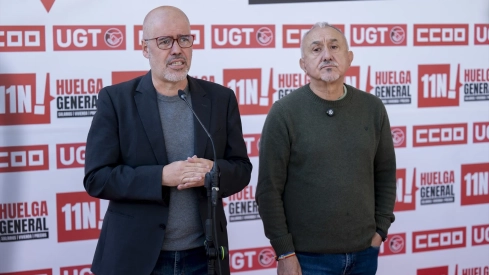
Since the last general strike in 2012, against the austerity policies and economic reforms of the Government of Mariano Rajoy and the directives of the European Union, Spain is a different country.
Fourteen years later, social, economic, and political transformation has drawn a different scenario, and the call for Wednesday, November 11, breaks molds both in form —who achieved the mobilization— and in substance —the reason that brings people to the streets—.
CCOO and UGT have given viability and legal coverage to a national strike promoted, for the first time, by agents outside labor unionism, such as the Tenants' Union.
Both central unions recognize that "the struggle has expanded" and that it is time to fight also on issues not strictly labor-related, such as housing.
Not all representative unions will support the strike: CSIF, USO, and Fetico question "the political moment" and refuse to join. Furthermore, a general strike had never before been held so close to an election, less than three weeks before the November 29 elections.
While the organizers are confident in a day that "will go very well," the employers reject the strike due to the absence of labor reasons: "it is a political strike," say those on the team of the CEOE president, Antonio Garamendi. The dispute is not minor: whether the strike is considered labor or political depends on its fit and legitimacy in public opinion.
The data supports the narrative
As the first general strike with housing as the main demand, it will predictably have more impact in strained areas or in those where market overheating generates more problems.
According to Idealista, October closed with a year-on-year increase in the asking rental price in Spain of 5.6%, reaching 15.1 euros/m². With the sole exception of Bilbao, where it fell by 1%, rents rose in the main markets: Palma (7.6%), Alicante (5.6%), Malaga (5.4%), Madrid (4.5%), Valencia (4.2%), Seville (3.3%), San Sebastián (1%), and Barcelona (0.3%).
It is in this area that the Tenants' Union focused, demanding solutions from administrations at all levels after Maricarmen's eviction. The case became one of the central issues of a pre-campaign also marked by the Urda (Toledo) railway accident, which caused 69 deaths.
The strike, however, has a double edge. The housing discomfort is compounded by the wage demand: salaries are not rising at the pace of the cost of living. The organizers thus seek to make visible a multifactorial problem and broaden the base of the mobilization. This conjunction is also their shield: linking wages and housing is what allows CCOO and UGT to defend the labor nature of the strike.
A strike with different parameters
Another particularity is that it cannot be assessed in advance with the usual parameters. A general strike is usually measured by participation in workplaces, electricity consumption, or the figures that each side disseminates at the end of the day. But this call combines labor and non-labor demands, and participation is not just about stopping work, which complicates any projection.
Added to this is a shift in focus. The unions will not emphasize the work stoppage as much as the mobilizations that take place on the afternoon of November 11 in the demonstrations. Measuring success in the streets, and not in factories and offices, also opens the door to a war of figures between organizers and the Administration in the middle of the campaign.
This shift fits the profile to which the call appeals: young people, the most mobilized in this cycle, as the encampments have shown. It is an audience less linked to the workplaces where a strike is traditionally measured, and whose response, for that very reason, is the most difficult to anticipate.
Affiliation data point in the same direction. A Funcas report published in February, which gathers information from the OECD and the international ISSP survey, places the unionization of full-time salaried employees aged 25 to 44 at 18%, eight points below the 26% registered by those between 45 and 64.
In a country where affiliation is around 12%-13% of salaried employees, the gap reveals a unionism with less roots precisely in the segment it is now trying to reach, and helps to understand why the protest has emerged outside its structures.
A different strike that points to everyone
“It is a strike that is not against anyone. It is in favor of a cause that has a name and surname, that of Maricarmen,” said the President of the Government and socialist candidate, Pedro Sánchez, a few days ago.
The Tenants' Union, however, insists on pointing to governments of all colors, due to a distribution of powers that goes from the central government to the autonomous communities and city councils.
The PP candidate, Alberto Núñez Feijóo, asked the unions to "reconsider that strike, called against the opposition." But the PP not only aspires to govern: it already exercises power in eleven autonomous communities, in the two autonomous cities, and in 3,193 municipalities, administrations that also have housing competencies.
Thus, the same strike allows for (at least) three interpretations. The PSOE presents it as a cause without an adversary; the PP, as a mobilization with a political recipient; the Tenants' Union, as a protest that challenges all administrations. This ambiguity partly explains its ability to mobilize, but it also raises a question that the campaign will not be able to avoid: if the problem belongs to everyone and competencies are distributed, who is responsible to those who take to the streets on Wednesday?