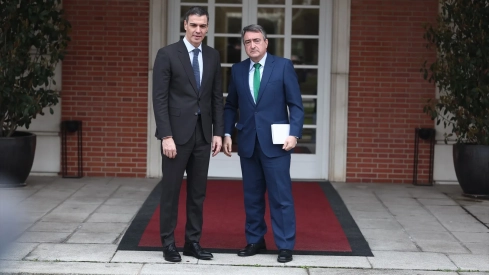
“The idea is to continue even acknowledging it”. This is how Moncloa responds to the latest message conveyed by the PNV, which considers the current political stage exhausted and places next autumn as the horizon to resolve the situation of the legislature. The Executive assumes the warning issued by the Basque nationalists, but maintains its intention to exhaust the mandate and preserve one of its most relevant parliamentary and institutional alliances.
PNV sources describe the political moment as a “devilish” situation and consider that the judicial calendar and the scarce legislative production hinder the continuity of the Executive. The jeltzales understand that the current political cycle is exhausted and have set the end of October as the date to clear the future of the legislature.
The PNV is also one of the partners most listened to by the Government of Spain and, in particular, Pedro Sánchez. The interest is not only due to the five nationalist deputies in Congress. Socialists and jeltzales govern in coalition in Euskadi and maintain agreements in a large part of the main Basque institutions: the autonomous government, the provincial councils and numerous municipalities, including the capitals.
Moncloa's message is better understood if one observes the parallel movement coming from Euskadi. The lehendakari, Imanol Pradales, demands from the central Executive that the bilateral meeting planned before the summer have concrete contents with the aim of closing pending commitments and culminating the development of the Gernika Statute.
In fact, the Basque leader conditioned said meeting this week on tangible progress. “If there are no concrete contents, there will be no bilateral”, he reiterated in the Basque Parliament.
And that double message —asking for a horizon for the end of the legislature while demanding pending commitments— has a political explanation.
Most parliamentary partners, not only the PNV, are uncomfortable with the judicial agenda surrounding the Government and, especially, by the lack of legislative progress. However, none are willing to facilitate the arrival of an Executive formed by the Popular Party and Vox, aware that an eventual sufficient majority of both formations would place them on the margins of the next legislature.
In addition, the Basque agenda and, in particular, the pending development of the Gernika Statute would be paralyzed with a PP and Vox Government in La Moncloa.
Therefore, the Executive trusts in continuing to offer political incentives to the PNV to maintain the legislature. Moncloa assures that it understands part of the Basque nationalists' diagnosis, although it maintains the objective of getting through the summer and, at least, trying to finalize the negotiation of the General State Budgets.
Regarding pending transfers —with the economic management of Social Security being the most sensitive issue for the central government and one of the main priorities of the Basque Executive— Moncloa insists on its "full willingness to dialogue," although for now it avoids specifying deadlines or contents.
Junts also raises the tone, but without taking effective steps
The spokesperson for Junts in Congress, Miriam Nogueras, has stated that the President of the Government, Pedro Sánchez, "has to leave or he will hand over the Government to the far right."
In an interview in El País, the independence leader warned that the president will be the "sole responsible" if Vox comes to power, since, she argues, he still has the option to step aside, as British Prime Minister Keir Starmer recently did.
Her words come the same week that the Popular Party's motion urging Pedro Sánchez to consider a vote of confidence passed. The initiative went ahead with 178 votes in favor, including those of Junts and Vox, against 171 votes against.
However, the situation remains ambiguous. Despite the fact that partners such as the PNV or Junts have notably hardened their discourse and increasingly verbalize the wear and tear of the legislature with fewer nuances, none are currently considering supporting a motion of no confidence promoted by the PP.
At the same time, both formations continue to facilitate governability in relevant votes. In recent months, they have supported the validation of a dozen decree-laws —the Government's main legislative tool that would give rise to debate— and have also supported, along with the parties of the progressive bloc, initiatives such as the law that punishes conversion therapies or the processing of the transfer of the AP-9 to Galicia.
The paradox for the Government is evident: its partners increase political pressure and verbalize the wear and tear of the legislature, but none are willing, at least for now, to assume the cost of precipitating elections that could open the door to a PP and Vox majority. This contradiction explains both the growing harshness of the discourse and the continuity of parliamentary support, and keeps Pedro Sánchez, for the moment, with room to resist.