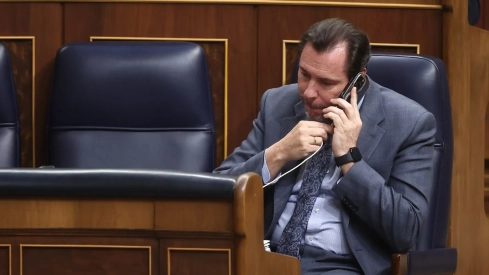
The resignation of the still Minister of Transport, Óscar Puente, once again gives a script twist to Spanish politics. It was not foreseen. Neither in La Moncloa nor in the leadership of the Socialist Party.
Among the first reactions on Ferraz street, they acknowledge that the announcement has caused a real "shock." "Nobody knew about the decision" that Puente had communicated to the President of the Government, Pedro Sánchez, just a few minutes before making it public, at the end of his appearance before the Permanent Deputation of the Congress.
The first reaction from the President of the Government came through the social network X. "Óscar Puente has shown his face, has provided solutions, and then has stepped aside," his message began.
"Out of dignity. Out of his own will. Out of respect for the victims and the progressive project. Politicians like him dignify our country and show us that not all of us are the same. While some only give lessons, others give everything," Sánchez pointed out, in a clear allusion to the Popular Party and the popular strategy of maintaining political reproach over the management of the accident.
"Thank you for so much, comrade," he concluded.
Sánchez's message is not just a farewell. It also contains a political reading. The president wants to turn Puente's decision into an argument to contrast two ways of understanding public responsibility: that of someone who assumes the political consequences of a management and that of those who, in the opinion of the socialists, avoid doing the same when it directly affects them.
Both the PSOE and La Moncloa had defended until now that it should be the citizens who judged the management of the Government and the minister himself at the polls, in the next elections on November 29. A few days before the campaign began, the socialists did not contemplate dispensing with a figure like Puente, whose profile had acquired a prominent weight in the political confrontation with the Popular Party.
His departure alters those plans. But it also allows the PSOE to try to close one of the main fronts of campaign desgaste: the permanent reproach from the popular over the political responsibility for the accident.
He will not be a candidate for Congress
Puente's decision also opens a new scenario regarding his political future within the PSOE. The former minister has announced that he will not be part of the socialist candidacy for the elections on November 29. His position as head of the list for Valladolid will be taken by the person who until now was second on the list.
Sources close to the Government acknowledge that Puente's profile was an electoral asset for a campaign that will now have to be reorganized twice: due to his departure from the Executive and due to the railway accident itself.
Sánchez's team assures that they will return to the campaign, although they insist that, for the moment, the priority remains to focus attention on the victims.
Between guilt and responsibility
Guilt is defined, mainly, as the imputation of an action to someone. And it is evident that the Minister of Transport, Óscar Puente, is not guilty of two high-speed trains colliding after a concatenation of errors whose causes are still being investigated. But what about responsibility?
Responsibility, in one of its meanings, refers to the moral charge or obligation that results for someone from a possible error in a given matter. And that is where the figure of the minister comes into play. As the highest political official of the department on which the Railway Infrastructure Administrator (Adif) depends, Puente is at the center of that demand for political responsibility.
It is precisely that distinction that has marked his farewell. "A Minister of Transport of a country like Spain cannot continue in office with two accidents like this, of this seriousness, in less than a year, whether or not he has direct responsibility."
With this confession, after four hours of appearance in Congress, the minister ended his time at the head of the Ministry of Transport and Sustainable Mobility, assuming political responsibility for the Urda accident.
His decision does not resolve the unknowns about the causes of the accident nor does it determine the responsibilities that may arise from the investigation. But it does introduce a new element into the political battle: Puente leaves the Ministry before the polls demand it and the PSOE intends to turn that gesture into a response to those who have been demanding for weeks that he assume responsibilities.
The message to the Popular Party is clear: if the popular ones want to continue using resignation as a political argument, the socialists already have an answer. Puente has resigned. And Sánchez wants that decision to serve to mark distances with those who, according to his narrative, have not acted in the same way when it has been their turn to assume responsibilities.