It is not the first time that historical events or catastrophes have forced a readjustment of plans and conditioned the political agenda. It has happened again this week and in La Moncloa decisions have already been made to provide a political response that the President of the Government, Pedro Sánchez, is anticipating.
Since his arrival at La Moncloa in 2018, Sánchez has faced a succession of extraordinary events that have conditioned his Executive's actions: the pandemic in 2020, storm 'Filomena' in 2021, the eruption of the Cumbre Vieja volcano on the island of La Palma, the passage of the DANA through the province of Valencia, or the historic blackout of 2025. To this list are now added, despite multiple warnings from firefighters year after year, the active fires in Madrid, Ávila, Toledo, and Castellón, which have forced the evacuation —for now— of 120,000 people, the equivalent of the entire population of Cádiz out of their homes.
Once again, this is an event —without going into the merits of the matter— that was not foreseen and that has forced administrations of different political persuasions to get to work.
Next Tuesday, the Government will hold the last Council of Ministers before the summer break and the head of the Executive will come out to make an assessment of the legislature, which closed this week with the last plenary session of the Congress of Deputies.
Aid for those affected and a State Pact
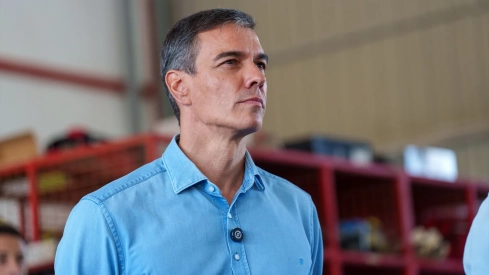
President Sánchez has already announced this morning, from the command post in Navaluenga, Ávila, that on Tuesday the Council of Ministers will declare the affected areas as severely damaged. The Executive is also studying other aid for the hundreds of thousands of affected people.
This is confirmed by sources from La Moncloa, who are already working on what will be Sánchez's last intervention, as an assessment, before the summer break.
Throughout the week, the president has made several calls to all political forces to reach a "great State pact against the climate emergency." That will be one of the central messages of his intervention. "The climate emergency kills," Sánchez said, a phrase that has become the core of the argument his communication team is working on.
"Data kills narrative," they say in La Moncloa
Congress has already concluded its parliamentary activity, giving way to silence in the chamber and significantly reducing the decibels that have marked the political course.
Despite parliamentary weakness and not having its own budget —the extended ones are already the longest in history—, the Government is determined to continue with the planned roadmap after the summer break. Sánchez intends, thus, to flood his appearance on Tuesday with data to “kill the narrative,” false according to La Moncloa, of those who claim that the Government is paralyzed. “None of that,” they state.
And it is that, despite defeats such as the recent fall of stability targets, the first step for the preparation of the budgets; the refusal of Congress, last April, to the text that sought to extend rentals, promoted by Sumar and rejected with the votes of PP, Vox and Junts; or the rejection of capping prices in emergency situations such as the DANA in Valencia, the Government claims to have approved more than 70 laws during this legislature, although close to 60% are royal decrees.
This is an increasingly recurrent formula that forces one to rush until the last minute to check if what has already been published in the BOE finally has the support of the parliamentary majority.
La Moncloa's strategy is, therefore, to contrast parliamentary weakness with management capacity and regulatory approval. The political objective on Tuesday will be to demonstrate that one thing does not necessarily imply the other.
Budget objective, without ruling out elections
Despite the increasingly pressing feeling that the legislature is moving on the margins, the Government maintains its course in the same coordinates and keeps the budgets as its main objective.
The context is not simple. Junts broke relations with the Government last autumn and only a possible return of Puigdemont —the Constitutional Court will address on September 22 the first appeal of a person convicted for the procés to apply the amnesty law— could rebuild bridges. Or not.
The PNV continues to demand a change of scenario and the lack of progress in pending transfers to Euskadi does not help to reinforce the confidence of a priority partner who has been raising the tone. For now, the planned meeting between Sánchez and the lehendakari, Imanol Pradales, has also been postponed until the beginning of the new and last course before the elections.
Also, Podemos has been acting as an opposition group for months, although it recognizes that, if social advances are proposed, it will vote in favor. At the same time, it insists on emphasizing that the legislature "is already exhausted."
However, and under the pressure of open judicial cases and an opposition that has only slightly lowered its tone due to the consequences of the devastating fires, the Government insists on working on public accounts that have accumulated three extensions after permanent non-compliance and outside the dictates of the Constitution.
From the Ministry of Finance, they insist that they "will go ahead" with the processing of the budgets, arguing that the State Attorney's Office supports continuing with the procedure even though the stability objectives have fallen twice in Congress.
And that is, at this moment, Pedro Sánchez's last political bullet: to occupy time and set the narrative around the need for public accounts that, this time, he intends to present in due time and form. Approving them is another matter.
If the project is finally rejected, it is more than likely that during the first quarter of the year, and when it suits him best, Sánchez will press the electoral button and bring forward the call to the polls by a few months, prior to the municipal and regional elections. This is the idea that, in private, several ministers who already anticipate that "the return in September will be of very high voltage" hold.
Because Tuesday will not only be a review of what has been done. It will also be the first political move for the decisive course. Sánchez faces the summer with a very specific objective: to arrive in September with the ability to demonstrate that the legislature still has a long way to go and that the Government retains room for maneuver. The approval of the budgets will be the litmus test. If it does not pass it, the electoral calendar could become the next strategic decision.
Add ElConstitucional.es as a preferred Google source for free.
Stay informed about all the latest breaking news with the best information. Against disinformation, for democracy and social rights.