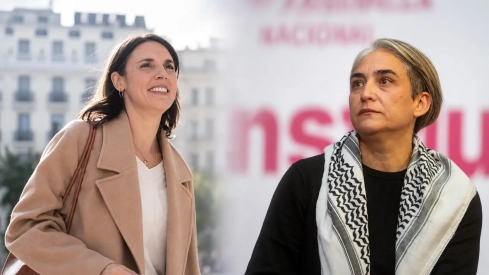
The electoral landscape of the alternative left is complicated by a fracture that goes beyond the distribution of positions on the lists. What was achieved in 2023 at the last minute, this time has been impossible. Podemos and the Broad Front will run separately in most territories, with only two exceptions: the Canary Islands and the Valencian Community.
The rupture leaves a difficult political paradox to avoid. The formations that appeal to unity to stop the right have not been able to build a common candidacy. Strategic differences, cross-vetoes, and the struggle for representation spaces have ended up prevailing over the shared objective that both directions claim to defend.
Sumar, now under the brand of the Broad Front, already tried in 2023 to end Podemos as a reference for the alternative left. Now, the purples seek, despite the risk of running separately, to become the sole reference of that political space. In parallel, Gabriel Rufián, who now acknowledges the "failure" of the negotiations, had as a priority to end the Comuns in Catalonia, a strategy that has also conditioned the scenario of division.
The leaderships of Podemos and the Broad Front, as well as Gabriel Rufián from ERC, have prioritized their respective strategies and have focused a good part of the debate on personalisms. The last offers, launched when the deadline was about to expire, have not served to close an agreement, but they have served to fuel a narrative of mutual recriminations. Each party seeks to prove that it did everything possible and to transfer the responsibility for the failure to the other.
The result leads the alternative left —the space located on the ideological board to the left of the PSOE— to a more complicated position for the upcoming elections. The dispute to explain the rupture thus threatens to become a battle parallel to the electoral one, while the formations face a campaign marked by division and the difficulty of presenting themselves as a cohesive alternative.
Out of play
Just as the deadline for registering electoral coalitions was about to expire, Podemos offered the Broad Front parties to reach agreements in several territories, but not in Madrid, where the purples believe that running separately does not penalize the vote, nor in Catalonia, where they already have an agreement with ERC.
Previously, the Broad Front had detailed in a statement a "concrete and real" proposal transferred to Podemos. The offer included a "priority" starting position for Madrid and Catalonia and, in the opinion of the formation, could "respond to the expectations" of the purples.
The formation led by Mónica García thus took a step forward and put forward an offer that days earlier had not been put on the table in those terms. Until then, the approach to the lists for Madrid did not contemplate a fit that would satisfy Podemos or Izquierda Unida.
The proposals arrived when the margin for negotiation was practically exhausted. The exchange of offers was not enough to unblock the conversations or to avoid a rupture that highlights the distance between the discourses of unity and the capacity of the leaderships to materialize them.
Without saving the furniture
Outside the two main strongholds, Madrid and Catalonia, where Podemos, the Broad Front and ERC have been trapped in their strategies and cross-vetoes, some territorial agreements have allowed for the maintenance of spaces for collaboration.
But the balance is limited. Podemos and the Broad Front have only closed agreements in the Canary Islands and in the Valencian Community. In the first case, together with Nueva Canarias-Bloque Canarista; in the second, within a coalition led by Compromís and completed by Esquerra Unida del País Valencià, Podem and Esquerra Republicana del País Valencià.
These are two exceptions that coexist with other alliances, such as the one announced past midnight between the PSOE and the Broad Front, which will run with joint lists for the Senate.
These agreements demonstrate that alliances are still possible when there is a will to achieve them. The question is why that will has not been enough to articulate a joint candidacy for the entire alternative left.
"Give the battle"
Faced with the same questions, the leaderships of both spaces resort to coinciding arguments. Both in Podemos and in the leadership that has worked to transform Sumar into the Broad Front, they claim to have done everything possible to reach an agreement and "regret" a result that "was not desired."
They also consider that, given the circumstances, the only thing left is to "give the battle" to snatch ground "from the right" and find a way to re-edit the formula for a future progressive government.
The discourse now looks forward, but it does not resolve the contradiction left by the negotiation: those who appeal to unity to stop the right-wing parties have not managed to agree on how to present themselves to the voters.