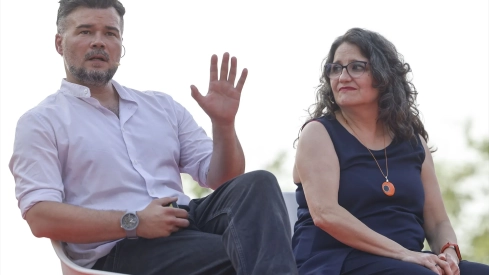
Evening falls over València and the amphitheater of Cabecera Park begins to fill. The concrete stands become too small for an event that exceeds the organization's expectations. There are people sitting on chairs outside the venue, people standing on the sides, and attendees looking for any space to see the event. In the background of the stage, the park's lake can be seen, with swan-shaped boats as the sun disappears.
The scene has something of a political comic strip: some irreducible Gauls trying to stand up to the advance of the far right, although each one arrives with their own journey. Without grand symbols or spectacular staging, the event relies on the people, the music, and shared emotion.
Far from the aesthetic of the event with Emilio Delgado, with fists on black backgrounds and a staging more typical of a resistance left. In Cabecera Park, the songs of La Fúmiga or Zoo provide the soundtrack to an evening that connects with several generations. Their themes mix with applause, shouts, and slogans from the stands: support for striking teachers and criticism of the Popular Party government.
It is not the same cycle that began with the Valencian Spring of 2011, but it does share recognizable elements: a mobilized civil society, indignation against the Popular Party government —which erupted with the DANA and was reinforced by the educational strike— and a citizenry that once again occupies public space to express discontent. All of this at a time when the Valencian Community becomes a key territory for the Spanish political landscape.
In this scenario, Mónica Oltra returns. The event marks her first major public appearance after four years out of the political frontline and an emotional reconnection with many Valencians who have been waiting for her for four years. She is now a candidate for Compromís for the Mayoralty of València and leaves Cabecera Park with renewed energy.
After her judicial ordeal, her return stands out for the vindication of hope. She refuses to build her discourse from resentment and avoids anger. The Oltra who returns to the stage is more humanist than ever, with echoes at times of Pepe Mujica. She also includes a critique of the super-rich and the extreme accumulation of wealth, quoting the mayor of New York, Zohran Mamdani.
Facing her, Gabriel Rufián represents another way of mobilizing. His ability to connect with citizens and translate complex problems into simple messages is one of his main virtues. When he began his tour, he did so with the will to promote a grand left-wing alliance, but the path has narrowed. What seemed like a proposal to articulate a common space throughout Spain now appears more limited, with Catalonia as the main terrain and more political will than a defined roadmap.
There appears the difference of the afternoon. Rufián seeks the formula to convert emotion into political structure. Oltra leaves with something more concrete: an activated candidacy and an emotional reconnection with her space.
Two leaders who share diagnosis and adversary, but who walk on different paths.
Today in Valencia, two responses are being rehearsed: Oltra's hope and Rufián's indignation. Oltra emerges strengthened as a candidate in the city. Rufián's future, however, remains uncertain.
Valencia begins to write its own political script. Pages that not only affect the Valencian Community, but also the balance of the country if the left aspires to retain or regain the State Government. The outcome will be written in 2027.