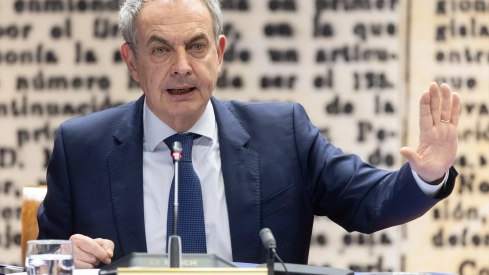
Awaiting to know the details of the summary and, above all, the appearance of the former president before magistrate José Luis Calama next June 2 at the Audiencia Nacional, Pedro Sánchez and his team have opted to deploy a message of tranquility and apparent normality that, in private, few now sustain with conviction.
For now, the Government has set aside the argument of lawfare. It can no longer attribute the investigation to an operation driven from the United States under the influence of Donald Trump, nor maintain that the far-right organization Manos Limpias —which opportunistically tried to claim credit for the case— is behind the indictment.
Although publicly ministers and socialist leaders maintain the defense line set by Moncloa, privately the fear of “burning their hands” or even “getting scorched” for a closed defense of Zapatero that could be compromised by the content of the summary and upcoming judicial decisions is beginning to spread. Some already recognize that the feeling of a legislature “hit and sunk” is understandable.
Sánchez travels to Roma with the shadow of Zapatero
Pedro Sánchez will travel to Roma on Tuesday and Wednesday, where he will hold a meeting with pope León XIV. His international agenda will prevent him from presiding over the meeting of the Consejo de Ministros and also from being absent from the Government control session in the Congreso scheduled for Wednesday morning.
All eyes will be on his appearance before journalists after meeting with the Pontífice. It will be the first since the judicial order was known and in it the indictment of José Luis Rodríguez Zapatero for criminal organization, influence peddling and document forgery within the framework of the alleged plot investigated in the Plus Ultra case will predictably monopolize the questions.
The Plus Ultra case erupts in the Congreso
Without last week's tension —marked by Sánchez's absence— the Congreso and the Senado now face a new parliamentary offensive from the opposition. Between Tuesday and Wednesday, several ministers will answer questions focused on the Plus Ultra case, Zapatero's indictment, and the different judicial fronts surrounding the Executive.
Corruption will also return to the center of the political debate with a motion promoted by the PP to demand accountability from the Government. The initiative will be debated on Wednesday morning, coinciding with a control session in which the opposition will insist on linking the judicial crisis with the political wear and tear of the legislature.
The “incredulity” of the partners and the strategic wait
The Government's parliamentary partners observe the situation with growing discomfort. After the fall of José Luis Ábalos and Santos Cerdán —two key figures in Sánchez's political architecture— and after the investigations affecting Begoña Gómez and the president's brother, in some formations they admit that Zapatero's indictment represents “another political dimension”.
“The next few days will be decisive,” acknowledge leaders of EH Bildu and ERC, where the perception of a possible end of the legislature is beginning to settle in.
For now, no one makes a move. The partners do not contemplate a viable exit with the elements on the table and wait for the Government itself to take the initiative. Nor do the nationalist formations most distant from Moncloa, such as Junts or the PNV —which do occasionally coincide with the PP in some votes— contemplate linking their votes to an eventual motion of no confidence supported by Vox.
At the same time, a mixture of incredulity and caution spreads among the Executive's parliamentary allies. They know they need to distance themselves and stay close to a possible emergency exit given what may become known in the coming days.
In Moncloa they insist on not altering the script and resisting until 2027. But the political framework has already changed. And this time it does not depend on Sánchez. It depends on the investigation, on the judge, and on whether Zapatero decides —or not— to tell everything.