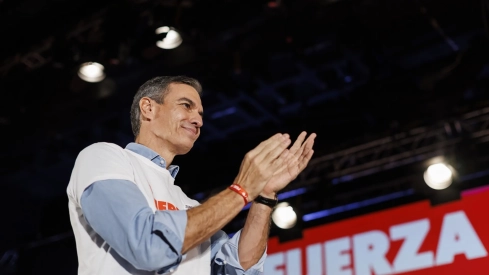
Optimism has settled among the socialists. Sources from Ferraz and La Moncloa show satisfaction with the first stages of a pre-campaign that they consider to have "favorable winds" and that they hope will be reflected in the upcoming electoral polls.
The agitation of the parties after the announcement of an election call does not, de facto, imply a reactivation of the bases, not even when the entire government and party apparatus is working at full capacity. However, this time, leaders of the socialist leadership believe that Sánchez has managed to "get dancing" an electorate that had not felt the excitement of fighting for a long time. "Now they are starting to see options," says a prominent member of Basque socialism, a territory where they aspire to be the leading political force.
The daily reading of the 'trackings'
Internal trackings are continuous surveys carried out by parties and campaign teams to measure the evolution of public opinion almost in real time. Each day they offer a snapshot that, added to the previous ones, allows to see the trend.
The models already handled by the PSOE and the Broad Front confirm a change in trend in favor of the progressive bloc. However, PP and Vox still add up to an absolute majority.
"We aspire to revalidate the progressive government," say sources from the team working with Ada Colau. However, the candidate herself acknowledges in an interview in elDiario.es that "there will not be a progressive government with only a good result from the PSOE."
Meanwhile, Pedro Sánchez's campaign team is working to increase the chances of the PSOE being the most voted party on November 29. With this purpose, in the coming weeks the socialist candidate will offer multiple interviews in different formats to "place the message" in all possible scenarios, his team explains.
They need to reactivate a vote that, according to various studies, was demobilized. Now they believe that abstention percentages are also changing. "People will go to vote," Sánchez's inner circle insists.
Feijóo, Sánchez's perfect antagonist
At the time of writing these lines, it is not risky to say that Alberto Núñez Feijóo will be the winner of the next elections.
What remains to be seen is the margin of victory, the weight of the far-right, and the distribution of seats that will determine the arithmetic for forming the future government.
Although in Genoa they assure that things "are going well" and downplay the credibility of the socialists' internal polls, Feijóo's stumbles give wings to Sánchez. In the first pre-campaign event, the leader of the PP spoke of "a Government that will ask for sacrifices" from the citizens, a framework that allowed the PSOE to fully enter the battle.
The pension reform, which according to national spokesperson Ester Muñoz will "explode", or the reopening of the debate on abortion are other issues that have placed the popular party in complex debates, given the number of people they affect: 10 million pensioners and half of the population, if we talk about women.
Analysis: a campaign to dispute the mood, not just the votes
Socialist optimism is, at the same time, a diagnosis and a tool. As a diagnosis, it relies on internal data that no one has contrasted outside of Ferraz. As a tool, it seeks something prior to the vote: to convince its own that the game is not lost. For a demobilized electorate, the perception of competitiveness can be the difference between staying home and going to vote.
But the PSOE itself recognizes the limit. Winning in votes does not equate to governing, and Colau's warning makes it clear: victory depends on the sum of the bloc, not on one party. There lies the political asymmetry of the moment.
Feijóo starts with an advantage in seats, but his ceiling depends on Vox, and that is why every stumble on pensions or abortion is so useful to the socialists: they are not looking to convince the right, but to remind the left why it must mobilize.