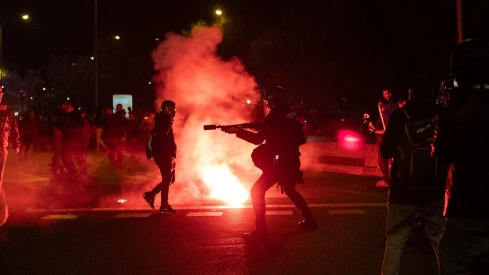
After the riots and looting that occurred in France or Italy, the 'Blocus movement' arrived in Spain through mass dissemination channels with calls made with AI, calling for the looting and destruction of public furniture, shops, vehicles and, ultimately, everything in its path. In this context, while cities like Madrid or Barcelona were armored against a new call, a dozen members of this movement have been arrested, including the one considered its leader. However, the most notable thing is that among those arrested are four minors, aged between 14 and 17.
Currently, although it is a coordinated police operation, the detainees are dispersed throughout the territory, so the question arises as to which body is competent for their prosecution. In this sense, the content of the accusation is more relevant than the place of detention, opening the possibility that the Audiencia Nacional (AN) may assume jurisdiction if elements of terrorism are appreciated. For the moment, the AN Prosecutor's Office itself has ruled it out because it is in a very early stage of the investigation, but they also do not completely close that avenue, appreciating the extreme seriousness of the communications in which instructions were given for the homemade manufacture of incendiary devices or 'street guerrilla' tactics.
However, perhaps the most notable aspect of the news is the arrest of four minors, which has transcendental legal consequences. In matters concerning minors, both the prosecuting body and the applicable 'penal code' change; it is no longer the ordinary one but rather the Organic Law 5/2000, on Criminal Responsibility of Minors (LORPM). This regulation provides for penalties of a very different nature, much more oriented towards education than punishment, and among which, obviously, ordinary imprisonment is not included. In this sense, the prosecuted minors could indeed be criminally responsible as they are all over fourteen years old, but in their case, the specific age of each one is decisive for the applicable measures. Although, given the facts, their admission to a closed regime in a juvenile center is not ruled out, this would always be accompanied by reform and rehabilitation measures. Should the AN decide to take over the case, the minors would be tried by the formerly called Central Juvenile Court, a specialized body of the AN for dealing with terrorism offenses committed by minors. Should admission to a closed regime be decreed, upon reaching the age of majority, they would not be automatically released, as many people mistakenly believe, but could continue serving this measure in an ordinary penitentiary center.
Nevertheless, investigators suggest that this movement does not respond to an ideology; that is, it does not conceive an instrumental use of violence for the achievement of objectives, as required by the crime of terrorism in art. 573 of the Penal Code, but rather that violent acts are an end in themselves. However, although it is not foreseeable that the investigation will be channeled through the path of terrorism, since many determining elements for this qualification are missing, the penalties would not be light or symbolic in the event of an eventual conviction. In the case of adults, depending on their degree of participation and their position in the organization, they could face prison sentences of around ten years, as well as be liable for an enormous amount of money in concept of civil liability derived from the damages caused.
