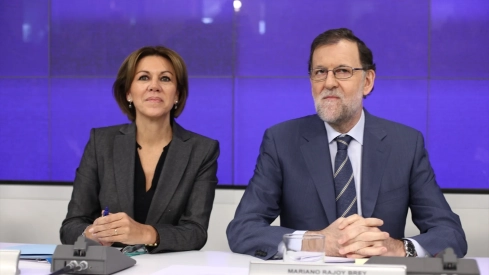
María Dolores de Cospedal said in 2014, in a conversation with commissioner José Manuel Villarejo, that the then President of the Government, Mariano Rajoy, had directly informed her that "complicated" documentation related to Luis Bárcenas had been found and that everything the former PP treasurer had had already been intervened and "cleaned" before.
The statement, contained in a police transcript from September 2014 now submitted to the Audiencia Nacional, raises questions about the knowledge that the then secretary general of the party and the president might have had of police operations linked to the Bárcenas case.
The judge who instructed the separate piece on the so-called "alleged" Kitchen plot exonerated Cospedal at the time, who was even charged for alleged participation in the organization of an irregular surveillance device and information gathering on Bárcenas, while Rajoy was never charged in that case.
The conversations now reviewed do not by themselves prove the existence of a criminal plan, nor have they been valued as evidence by any court, but some experts consider them indications that deserve to be analyzed regarding political knowledge of police operations and documentary findings linked to the PP's financing scandal.
"The president told me, no one else told me"
In an exchange of the Cospedal-Cataluña conversation, from September 15, 2014, Villarejo tells Cospedal that "a month ago, complicated documentation" was found in an operation that he attributes to his police circle.
When asked if they or the CNI had found it, Villarejo replies: "No, we found it." It is then that Cospedal states:
Villarejo: «[…] a month ago, complicated documentation was found, I don't know, I hope the Minister has given it to the president.»
Cospedal: «But did you find it or did the CNI?»
Villarejo: «No, we found it.»
Cospedal: «I know that before they had found and more or less had cleaned this [Bárcenas] of everything he had. The president [Rajoy] told me, no one else told me.»
The passage, transcribed in the police report sent to Central Investigating Court No. 6, is one of the most cited in recent months because it literally records Cospedal's statement attributing to Rajoy direct knowledge of interventions and "clean-ups" of material concerning Bárcenas.
In the same block, Villarejo adds that "I hope the Minister has given it to the president," referring to the "complicated" documentation found more recently.
"I know that Rajoy has allowed the other one to maintain communication channels"
In another part of the same conversation, Cospedal and Villarejo talk about Javier Arenas's position in the party and his relationship with Bárcenas. Cospedal says:
Cospedal: «Arenitas is still there because he's been saying for two years that if Rajoy doesn't make him a minister, he's leaving. What the hell is he going to leave for!»
Villarejo: «He's not going to leave. But Rajoy supports him.»
Cospedal: «Yes, I know, of course he supports him. He supports him so much that he has him safely tucked away here. And he hasn't cut off the communication channels, I know it: I know that Rajoy has allowed the other one to maintain the communication channels, I know it, I know it. Just so you know I know it, huh?»
The expression "communication channels" has been interpreted by some investigators in the context of the investigation as contact channels or information flow with Bárcenas, at a time when the party was trying to contain the political damage of the case.
The fragment shows Cospedal emphatically asserting that Rajoy maintained certain channels open with the former treasurer.
"The president had been a bit worried… let's see if this guy is going to leave us with the Bárcenas thing"
Villarejo mentions on several occasions that the concern about the "Bárcenas case" reached the top of the Executive. In a 2014 passage, he states:
Villarejo: «And if you have a chance to talk, I was going to tell you with… well… what Javier Iglesias has conveyed to me is that the president had been a bit worried, he says: "Damn, let's see if this guy is going to leave us with the Bárcenas thing and all that." If you have a chance, tell him that the retirement thing is quite the opposite, that is, what I want is to get away from the fools I have next to me…»
At another point, Villarejo alludes to "the Minister having informed the President that you were leaving," referring to his own early retirement.
These references place the management of the Bárcenas case and Villarejo's situation at the highest level of the Government, although they do not, by themselves, allow concluding the existence of concrete instructions to set up an illegal device.
"Even the name of the Prime Minister was included"
In a conversation in April 2013, in the midst of the storm over the publication of the Bárcenas papers, Villarejo tells Cospedal that the name of the head of the Executive appeared in a police report on the list of alleged beneficiaries of payments:
Villarejo: «[…] even the President's name was in the report, huh? I don't know if you know that.»
Cospedal: «No.»
Villarejo: «Even the Prime Minister's name was in it. The entire list reproduced from El País was in it.»
The passage connects with the famous publication by El País of Bárcenas' alleged accounting and shows how, from the Police, the idea was handled that the document also affected the president.
At the same time, Cospedal and Villarejo coordinate responses to media pressure and discuss the party's strategy against the accusations.
Cospedal exonerated, Rajoy, outside the case
The Audiencia Nacional investigated in the separate piece known as the "alleged" Kitchen plot the alleged organization of an irregular espionage and pressure device on Bárcenas, with the aim of obtaining information and conditioning his testimony.
Cospedal was even charged with possible crimes of revealing secrets, bribery, and criminal organization, but the instructor later exonerated her and she was not brought to trial for those facts.
Rajoy was never charged in that case, although his name appeared in multiple testimonies and documents as a political reference in the Bárcenas case.
The transcripts now provided do not, by themselves, modify that procedural situation, and no court has valued them as proof of guilt, but some experts consider them evidence that could reinforce the narrative that both the general secretary of the PP and the president had knowledge of police operations and sensitive documentary findings related to Bárcenas.
The key to a possible reopening or expansion of lines of investigation would be to prove whether that knowledge translated into instructions, active tolerance, or cover-up of illegal practices, an extreme that has not been proven to date.
Why it matters now
The document containing these conversations is a police report from the Internal Affairs Unit (UAI) from September 2026, sent to Central Investigating Court No. 6 in response to a judicial request regarding indications of criminality in the material seized from Villarejo.
Its appearance coincides with a renewed interest in episodes of political espionage and irregular financing of the PP, and with the perception that some of the political leaders of that time never faced a court despite the serious accusations.
Cospedal's statements attributing direct knowledge to Rajoy of "clean-ups" of material about Bárcenas, and references to reports that "went up to the President's name," raise questions about the role of both in Villarejo's operations, at least as knowledgeable parties of key operations and documents.
The question that remains open is whether that knowledge was passive or somehow involved the authorization or tolerance of methods outside the law, an extreme that has not been judicially proven.
