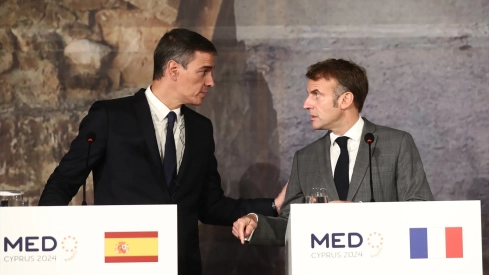
The Treaty of Friendship and Cooperation signed by Pedro Sánchez and Emmanuel Macron has received this Wednesday its most important legal backing since its eventful processing began in Spain. The magistrate of the Constitutional Court Ricardo Enríquez has presented a report favorable to the constitutionality of the agreement and proposes rejecting the doubts raised by the Senate.
The Plenary of the Constitutional Court will study the matter next week and legal sources consider it probable that the proposal will gain the support of the majority. The document must still be submitted to the deliberation of all magistrates, but it offers the Government a first favorable response after the successive parliamentary obstacles that have delayed ratification.
The calendar adds political relevance to the debate. The Constitutional Court will address the treaty a few days before Macron's State visit to Spain, scheduled for September 29 and 30. The French president will be received by the King and Queen and will hold a meeting with Sánchez at La Moncloa, where the bilateral relationship will occupy a central part of the agenda.
The clause questioned by PP and the far-right Vox
The conflict is concentrated in article 2.4 of the agreement, which establishes that "a member of the Government of one of the parties will be invited to the Council of Ministers of the other party, at least once every three months and by rotation". The PP and Vox consider that this formula may violate the Constitution by allowing the presence of a foreign minister in the highest collegiate body of the Spanish Government.
To clear up these doubts, the Minister of Foreign Affairs, José Manuel Albares, and his French counterpart, Jean-Noël Barrot, exchanged interpretative letters in April. Both governments agreed that the meetings would be held "on the sidelines" of the Council of Ministers, through a separate meeting and without the foreign representative participating in the deliberation or voting of the Executive.
Enríquez's report, a magistrate from the conservative sector of the court, considers this interpretation sufficient. His proposal argues that article 98 of the Constitution regulates who is part of the Government, but allows legislation to determine the attendance of other people at meetings to report on specific matters. The invited minister would maintain an institutional presence, without voice, vote or capacity to intervene in decisions.
The Senate took the treaty to the Constitutional Court for the first time in 2025. The court ended up shelving that procedure after Congress rejected the authorization and the consultation lost its purpose.
The Government resubmitted the agreement to the Cortes and managed to approve it in Congress last June. After that, the PP and Vox majority in the Senate promoted a second consultation with the Constitutional Court and again suspended the ratification.
The declaration issued by the court now will be binding. If the Plenary supports the report, the parliamentary process can resume with the main legal obstacle cleared. France completed its ratification in March 2025 and remains awaiting Spain to conclude the procedure.
A strategic alliance with France
Sánchez and Macron signed the so-called Treaty of Barcelona in January 2023. The agreement elevates cooperation between the two countries in foreign policy, defense, security, justice, interior, education, culture, industry, agriculture, energy, transport and interconnections, in addition to reinforcing the coordination of the territories located on both sides of the Pyrenees.
Its approval would place the Spanish-French relationship at a level similar to that of the treaties maintained by France with Germany and Italy. It would also allow for more regular coordination of the positions of Madrid and Paris within the European Union, especially in debates on strategic autonomy, defense, energy, migration and industrial policy.
The proximity of the constitutional decision offers Sánchez and Macron the possibility of reaching their next meeting with the agreement closer to being unblocked. The official agenda released by La Moncloa sets their meeting for 12:00 PM on September 30 and places the visit within the work of both governments to continue strengthening their cooperation.
The Plenary of the Constitutional Court will deliberate next week on Enríquez's proposal. A favorable ruling will allow the reactivation of Spanish ratification with French approval already deposited a year and a half ago.
Add ElConstitucional.es as a preferred Google source for free.
Stay informed about all the latest breaking news with the best information. Against disinformation, for democracy and social rights.
