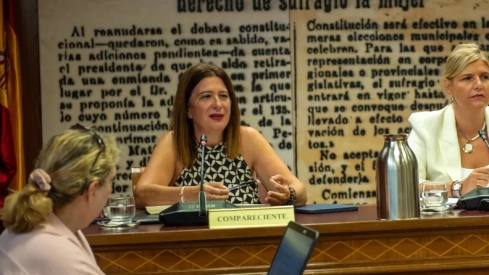
Leire Díez has opened a double judicial front this Thursday to try to prevent Santiago Pedraz from concentrating in the Audiencia Nacional the two cases in which she is being investigated. The former PSOE militant has appealed the decisions that allowed the transfer to the magistrate of the investigations opened in Madrid regarding her alleged maneuvers against prosecutors, judges, and Guardia Civil commanders.
Her defense has challenged both Pedraz's order incorporating the proceedings and the decision of Madrid judge Arturo Zamarriego to recuse himself and hand over the investigation. The Criminal Chamber of the Audiencia Nacional will have to review the first movement, while the Provincial Court of Madrid will have to rule on the second.
The appeals arrive with the transfer already materialized. Officials from Instruction Court number 9 of Madrid brought 14 volumes with 3,847 pages to the Audiencia Nacional last Friday, the result of an investigation initiated in the summer of 2025.
Zamarriego agreed to cede the case after considering that the investigations were "indissolubly" linked and that their clarification required a single instruction. Pedraz accepted this approach and received a procedure affecting Díez, businessman Javier Pérez Dolset, and journalist Pere Rusiñol for alleged crimes of bribery and influence peddling.
The accusation against the UCO
The appeal directs its harshest reproaches against the Central Operative Unit of the Guardia Civil. The defense argues that the agents opened a "parallel" and "secret" investigation in the Audiencia Nacional when they already knew of the existence of the proceedings directed by Zamarriego.
Díez argues before Pedraz that there is a "material identity of facts and investigated subjects". According to her version, the UCO incorporated into the Audiencia Nacional case actions that were already being examined in Madrid and carried out proceedings that the first instructor had rejected.
She also questions the treatment given to Santos Cerdán and Gaspar Zarrías. Both appeared as witnesses before Zamarriego, with the obligation to respond and tell the truth, while the investigations of the Audiencia Nacional ended up placing them as investigated. The defense considers that this circumstance may have affected their procedural guarantees.
The former socialist militant also maintains that the transfer of the 14 volumes occurred before the appeals filed against the union were resolved. Her brief invokes the right to defense, the principle that prevents investigating the same facts twice, and the guarantee of being judged by the body previously established by law.
The second front questions the jurisdiction of the Audiencia Nacional itself. Díez argues that the possible crimes of bribery and influence peddling investigated in Plaza de Castilla correspond to an ordinary court in Madrid and recalls that it was Zamarriego who first opened the proceedings. She also warns that grouping all the facts can cause "procedural elephantiasis" and turn the investigation into a difficult-to-manage procedure.
Two investigations that now converge
The case initiated by Zamarriego has focused for more than a year on the alleged efforts of Díez, Pérez Dolset, and Rusiñol to obtain compromising information about UCO commanders and members of the Anti-Corruption Prosecutor's Office. Investigators are trying to clarify whether they offered personal or professional advantages in exchange for data that could discredit those working on sensitive procedures for the PSOE.
Among the episodes examined are the contacts with prosecutors José Grinda and Ignacio Stampa, a meeting with Civil Guard commander Rubén Villalba, and several meetings allegedly aimed at gathering information about UCO Lieutenant Colonel Antonio Balas. All these actions remain under investigation and still lack a firm judicial resolution.
The proceedings led by Pedraz began around alleged rigging of public contracts linked to the State Society of Industrial Participations (SEPI). The procedure affects the former president of SEPI Vicente Fernández and businessman Antxon Alonso, and has been extended in recent months to former socialist officials such as Cerdán and Zarrías, in addition to the PSOE manager, Ana María Fuentes.
The material seized during that investigation led the UCO to delve into the activities of Leire Díez and her contacts with political leaders, businessmen, and heads of public institutions. Pedraz considers that his case has a broader scope, includes more crimes, and allows examining the possible intervention of people with greater responsibility within the investigated network.
That argument ended up convincing Zamarriego, who agreed to step aside from the instruction at Pedraz's request and with the support of the Prosecutor's Office. The defense now intends to reverse the transfer and keep separate the investigations into the alleged contract rigging and the alleged maneuvers against investigators and prosecutors.
The Criminal Chamber of the National Court and the Provincial Court of Madrid will decide whether the 14 volumes and 3,847 pages remain under Pedraz's direction or if a part of the investigation returns to the court that opened the first proceedings in 2025.
