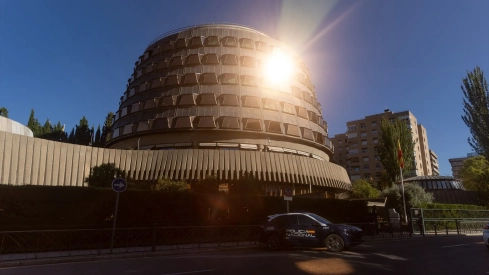
The Constitutional Court has closed this Friday the general examination of the amnesty law. The Plenary has rejected the appeal filed by the Junta de Extremadura, chaired by the popular María Guardiola, and has considered resolved the 22 challenges promoted against the norm since its approval in June 2024.
The ruling has been drafted by the vice-president of the court, Inmaculada Montalbán, and once again applies the doctrine established a year ago. The majority considers that the Constitution allows Parliament to approve an amnesty and that the measure pursues the legitimate objective of reducing political and social tensions generated by the Catalan independence process.
The Extremaduran appeal was the last of the 16 pending unconstitutionality appeals. To these were added six questions raised by the Supreme Court, the High Court of Justice of Catalonia and the Provincial Court of Madrid. The closure reaches the abstract control of the norm, although the Constitutional Court will still have to decide how it should be applied to leaders convicted or prosecuted for embezzlement.
What the Extremadura appeal questioned
The Junta demanded the complete annulment of the law and argued that the Constitution lacked authorization to grant amnesties. It also denounced a possible violation of the separation of powers, legal certainty, effective judicial protection and the exclusivity of judges to judge and execute what has been judged.
The Constitutional Court rejects all these arguments and rules out that the norm can be considered a self-amnesty. The ruling recalls that the law was debated and approved by the Cortes Generales within a democratic system and that its beneficiaries lacked the capacity to grant themselves the extinction of their responsibilities.
The majority also denies that the legislator acted arbitrarily. The reduction of political and institutional tensions in Catalonia constitutes, according to the court, a legitimate purpose that can justify an exceptional measure of renunciation of criminal punishment.
Part of the allegations presented by Extremadura had lost their object after previous decisions. The first ruling on the amnesty, issued on June 26, 2025, corrected the unequal treatment that left out certain acts committed to oppose the 'procés' and annulled the paragraph that extended the temporal scope of the law beyond November 13, 2023.
That ruling also set the conditions for lifting precautionary measures and maintained the core of the norm. The Constitution's silence on amnesty, according to the doctrine approved then, cannot by itself become a prohibition for Parliament.
Four magistrates maintain their rejection
The resolution again includes the dissenting votes of Ricardo Enríquez, Enrique Arnaldo, Concepción Espejel, and César Tolosa. The four magistrates from the conservative sector maintain that the amnesty lacks constitutional fit and question both its political origin and its effects on equality and the separation of powers.
The division has dragged on since the June 2025 ruling, approved by the six magistrates of the progressive majority against the four votes of the conservative bloc. José María Macías remains excluded from general procedures on the norm due to his participation in the report that the General Council of the Judiciary prepared before his arrival at the Constitutional Court.
Despite this internal fracture, all subsequent challenges have been resolved through the doctrine established in the first ruling. The appeals promoted by the popular groups of Congress and the Senate, the regional governments and parliaments of the PP, and the socialist Executive of Castilla-La Mancha have already completed their course.
The ECJ's backing strengthens the law
The latest Constitutional Court ruling comes a week after the Court of Justice of the European Union concluded that Community law also does not oppose the Spanish amnesty. Luxembourg endorsed its application to accounting liability derived from the expenses of the 'procés' and to certain terrorism offenses that lack serious intentional human rights violations.
The ECJ recognized that the approval of an amnesty belongs to the scope of competence of the Member States and accepted its purpose of facilitating a scenario of reconciliation. It also established that the two-month period provided for in the law may be suspended while a Spanish court awaits the answer to a preliminary question.
The two pronouncements examine different legal planes. The Constitutional Court has confirmed the law's fit within the Magna Carta, and the ECJ has ruled out its general incompatibility with the European norms analyzed. Its application to each procedure will remain in the hands of Spanish judges.
Embezzlement arrives in September
The next battle will begin on September 22 with the appeal filed by Jordi Turull. The former minister of the Generalitat appealed the Supreme Court's decision to uphold his conviction for embezzlement, considering that he had obtained a patrimonial benefit by saving the expenses of the 1-O referendum.
The same problem affects Oriol Junqueras, Raül Romeva, and Dolors Bassa, as well as those prosecuted in absentia Carles Puigdemont, Toni Comín, and Lluís Puig. The Supreme Court has so far interpreted that this form of embezzlement falls outside the law.
Turull's appeal will mark the Constitutional Court's first response to that interpretation. Afterwards, the other pro-independence leaders will follow, including Puigdemont. The 16 appeals and the six questions against the law are already closed. The fight for its main beneficiaries will begin next September 22.
Add ElConstitucional.es as a preferred Google source for free.
Stay informed about all the latest breaking news with the best information. Against disinformation, for democracy and social rights.
