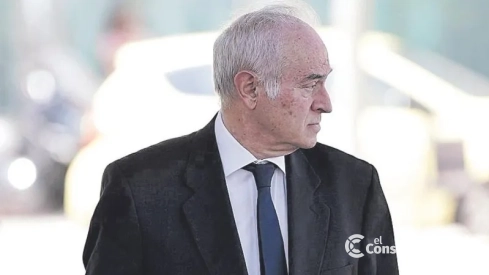
The controversial judge Juan Carlos Peinado has seen how two of the six complaints examined by the General Council of the Judiciary surpassed the proposal for dismissal. The Permanent Commission agreed this Tuesday to send them to the High Court of Justice of Madrid to determine if the instructor of the 'Begoña Gómez case' incurred in respective minor offenses of inconsideration and delay.
The decision required the casting vote of the president of the CGPJ, Isabel Perelló, after a tie between the members in favor of continuing and the conservative bloc, which has announced dissenting votes. The agreement deviates from the criterion of the promoter of Disciplinary Action, Ricardo Conde, who had requested to dismiss the six proceedings opened against Peinado.
The referral also does not imply that the governing body of judges considers an infraction to be proven. The final word now rests with the TSJM, which may close the proceedings or initiate the procedure to sanction him.
The scope of the punishment is already limited by the classification of the facts. The Organic Law of the Judiciary establishes that a minor offense can only receive a warning, a maximum fine of 500 euros, or both sanctions jointly. The legal label thus reduces the possible reproach against the magistrate, although one of the behaviors directly affects the agents in charge of protecting the family of the President of the Government.
Peinado put the Police in a hypothetical escape
The first proceeding comes from the order in which Peinado withdrew Begoña Gómez's passport, prohibited her from leaving Spain, and imposed periodic appearances. The judge maintained that her escorts could collaborate in a possible escape, "either on their own initiative or following orders from their hierarchical superiors."
The statement turned the police officers in charge of protecting Gómez into possible collaborators in an escape that was also not supported by concrete data. The Provincial Court of Madrid subsequently revoked all precautionary measures and described Peinado's reference to the agents as "unfortunate".
Ricardo Conde argued that expressions included in a judicial resolution could only be examined through disciplinary channels if the court in charge of the appeal previously remitted testimony. The majority of the Permanent Commission has rejected that interpretation and recalls that the Supreme Court has already allowed sanctioning disrespectful expressions without requiring that procedure.
The cited precedent corresponds to a 2014 ruling that confirmed the suspension of a magistrate for using disqualifications against the Generalitat of Catalonia in several resolutions. The Supreme Court then appreciated a high degree of contempt improper of someone exercising jurisdictional functions.
The second proceeding affects a procedure for alleged slanders against journalist Nacho Abad. His defense requested dismissal on June 12, 2024, but Peinado did not respond until January 14, 2026, when he refused to close the case and decided to proceed to trial. The TSJM will study whether those 19 months constituted an unjustified delay, despite the disciplinary promoter also finding no reasons to sanction him.
Four files and the retirement clock
The CGPJ has archived the other four proceedings examined this Tuesday. The most relevant had been promoted by Minister Félix Bolaños after his testimony as a witness in La Moncloa. Bolaños denounced the treatment received by Peinado and several demands he considered anomalous, among them the request for an official vehicle to enter the presidential complex and a platform that would place the judge above the declarant.
The majority has considered that those actions were linked to debatable procedural interpretations, but lacked disciplinary entity. It also admits that the interrogation took place "in a climate of tension", although it rules out that there were explicit disrespects against the minister.
Progressive members Argelia Queralt and Bernardo Fernández opposed the archiving. Both argue that the conduct should be examined as a whole and that the repetition of warnings, the reproaches about the answers, and the censures of Bolaños' gestures exceeded a simple discussion during the interrogation.
Also, the complaint by Cristina Álvarez for the leak to a media outlet of the content of a ruling that had not yet been issued has been shelved. The prosecutor concluded that there was not enough evidence to attribute the leak to Peinado himself, although several members criticized the checks carried out as insufficient to locate its origin.
The Council also closes the proceedings initiated by Más Madrid and socialist deputy Guillermo Hita for the out-of-time extension of a case for embezzlement. The fourth complaint, filed by an investigated person who reported inconsiderate treatment and the refusal to testify by videoconference, has been unanimously shelved as it affected decisions that could be appealed before another judicial body.
The calendar may end up being the main protection for the controversial judge. Peinado will retire next September 27 and will then cease to be subject to the disciplinary regime of the judicial career. Any open file when he leaves active service will lapse without sanction.
Add ElConstitucional.es as a preferred Google source for free.
Stay informed about all the latest breaking news with the best information. Against disinformation, for democracy and social rights.
