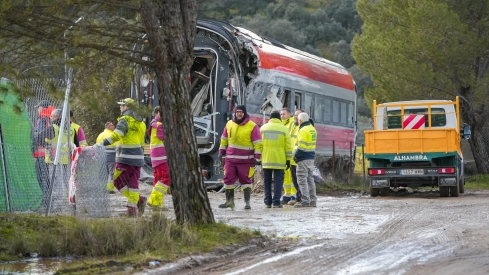
The judge investigating the Adamuz railway accident has given ten days to the Civil Guard, judicial experts, and the Independent Administrative Authority for the Technical Investigation of Railway, Maritime, and Civil Aviation Accidents and Incidents (Aitat) to report on the status of the case.
The magistrate of the Civil and Instruction Section of the Montoro (Córdoba) Court of First Instance, seat number 2, adopts this measure in a ruling dated November 6, to which Europa Press has had access, noting the time elapsed since the initiation of the investigation, the complexity of the facts, and the need to expedite its clarification. The accident, which occurred on Sunday, January 18, caused the death of 46 people and left more than 120 injured, but the investigation remains open with pending proceedings and expert reports.
The investigation requests concrete progress and separates functions among technical teams
The judge asks the Organic Unit of Judicial Police (UOPJ) of the Civil Guard for an update on the status of the investigation, including actions taken, results obtained, pending proceedings, and a forecast of conclusions based on what has been done.
She requests from the judicial experts an update on the commissioned expert report, with available preliminary results and actions yet to be carried out. From Aitat, she requests a summary of the status of its technical investigation, "without prejudice to the autonomy and specific regime of its investigation."
The magistrate also clarifies to Haslerrail, manufacturer of the legal recorders, the black boxes, and provider of the necessary tools to access the information, that the report it must submit must be descriptive of the actions performed and the results obtained during the proceeding. This work includes, according to the ruling, assistance in loading and visualizing records, identification and technical explanation of signals, configuration of graphic views and chronology, and necessary checks of the recording system.
The transfer of Iryo wagons enters judicial examination phase
The judge also asks the Public Prosecutor's Office to report on the transfer of the five wagons of the crashed Iryo train, in view of ILSA's proposal to move the bogies by road to Pinto (Madrid), where they are provisionally sealed at Villanueva de Córdoba station. The consultation also extends to the visual inspection and possible transfer of wagons 6, 7 and 8, the most affected in the accident.
In a letter dated November 7, the judicial experts consider ILSA's alternative proposal, consisting of separating the bogies from the rest of the cars and transferring the former to Alstom's maintenance workshop in Pinto, to be "adequate" for the investigation. As they explain, this action would allow the bogies to be sealed, their custody secured, and the evidence preserved for a possible subsequent inspection, although the final decision remains pending the judge's discretion. The experts add that the car bodies 1 to 5, once the bogies have been separated, "are not of interest to the ongoing investigation and can be released," but they emphasize that it will be necessary to attend and visually inspect the process of uncoupling, hoisting, and depositing these bodies in the means of transport provided by ILSA.
They also maintain that the separation of the five bodies offers a particularly opportune moment to review elements not accessible in other phases, including the connections between cars, the lower chassis, and other components of cars 1 to 5 that could have damaged the infrastructure due to dragging or snagging at the time of the accident or immediately before. The experts add that this visual inspection of the lower part is equally necessary in cars 6 to 8, although these wagons are not the subject of the current order and their removal has not yet been defined.
In parallel, the diligence of access, deciphering, and interpretation of the data from the black boxes of the Alvia and Iryo trains is still scheduled for Thursday of this week, with the participation of the intervening technicians, except for the judicial experts, who must focus their report on the interpretation of the global behavior of each train, the correlation of its subsystems, and the search for possible causes and contributing factors of the accident.
Contact
We are listening. Get in touch.
