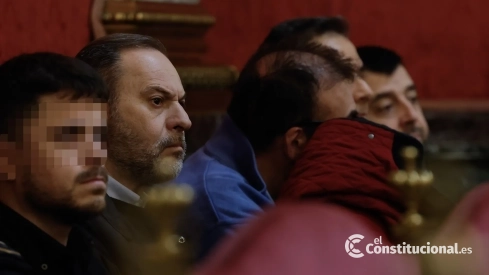
The judgment in the mask case published yesterday no longer only stands as a judicial resolution against José Luis Ábalos, Koldo García, and Víctor de Aldama, but probably as the biggest political and criminal blow received by the socialist circle since the plot erupted in February 2024. The Supreme Court has sentenced the former Minister of Transport to 24 years and three months in prison, his former advisor to 19 years and eight months, and the businessman to four and a half years, although the latter will not go to prison due to his collaboration with justice.
The ruling considers it proven that the three formed a criminal organization with a division of functions to take advantage of Ábalos's position in the Government and the PSOE. The plot acted around contracts awarded by agencies dependent on the Ministry of Transport, such as Puertos del Estado and Adif, in the midst of the pandemic. Those operations moved tens of millions of euros in mask purchases and, according to the judgment, served to feed a network of commissions, cash payments, personal favors, and dealings with the Administration.
The historic conviction of Ábalos
The sentence for Ábalos is one of the central keys to the ruling. The Supreme Court attributes to him crimes of criminal organization, bribery, embezzlement, and influence peddling. The judgment places the former minister as a powerful piece within the plot. The magistrates consider proven monthly payments of 10,000 euros for his "fixed expenses," rents linked to people in his circle, hires in public companies, and dealings related to Aldama's business interests.
The court also emphasizes the institutional damage of the events. Corruption, the Supreme Court warns, is not limited to stolen money or administrative infractions. In a case like this, with a government minister and PSOE Organization Secretary convicted, the impact reaches citizen trust and the democratic architecture itself. That phrase weighs especially heavily in Moncloa, because it turns the judgment into more than just a closed criminal case against a disgraced former leader.
Aldama avoids prison and opens the biggest debate
The most uncomfortable point of the resolution is in Aldama. The businessman is sentenced to four and a half years, but the Supreme Court suspends the execution of the sentence because no individual sentence exceeds two years and because it appreciates a relevant collaboration to clarify the facts. In return, he must not commit crimes, appear every six months to report on his activity, and perform one year of community service.
The decision has caused discomfort even within the Government. Minister Óscar Puente summarized it on X with a phrase that marked the political reading of the day: “It paid off for him.” Vice President Yolanda Díaz also showed her surprise that “the corruptor” does not go to prison. The reproach points to the same place: the Supreme Court harshly punishes public officials, but the businessman who benefited from the system gets the most favorable treatment for having collaborated.
The Government condemns Ábalos "without nuances"
Moncloa has reacted with an “unqualified” condemnation of the facts and with an evident attempt to separate Pedro Sánchez from who was one of his strongmen. Ábalos was not just any minister. He was the PSOE's Organization Secretary, a key member of Sánchez's first Government, and the leader who defended the motion of no confidence against Mariano Rajoy with the PP's corruption as the political axis.
That biography explains the immediate offensive from the right. Alberto Núñez Feijóo has called for elections and recalled that the convicted man was “Sánchez's minister who promoted a motion against corruption.” Isabel Díaz Ayuso has also demanded that the president call for elections. On the far-right Vox, Santiago Abascal has gone further and used the sentence to predict that Sánchez will end up in prison when he leaves the Presidency, although the ruling does not judge or condemn the head of the Executive.
Partners warn the PSOE
The problem for Sánchez does not only come from the opposition. New pressure has also emerged from the parliamentary left. Gabriel Rufián has asked “to endure for what?” and has warned that “to govern is to legislate, not to resist.” ERC's message makes it clear that the partners do not want the legislature to be limited to resisting the judicial and political desgaste of the PSOE.
Sumar has asked the socialists to “clean their house” and not become a burden for the coalition government. The party rejects the early election demanded by the PP, but calls for explanations, anti-corruption measures, and a real legislative agenda. Sánchez's appearance in Congress is now marked by this double pressure: the right wants ballot boxes and his partners want content. The Ábalos ruling has closed a judicial case, but has opened a critical week for the Government.
Add ElConstitucional.es as a preferred Google source for free.
Stay informed about all the latest breaking news with the best information. Against disinformation, for democracy and social rights.
