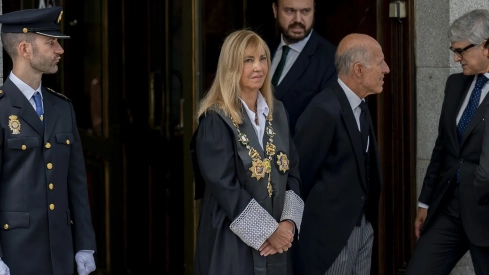
The new judicial year has started this Thursday in a context marked by tensions between the Judiciary and the Government of Spain. The solemn opening ceremony, presided over by King Felipe VI, is held after several institutional clashes related to judicial decisions and actions that have escalated the confrontation between both powers.
Among the issues that have contributed to this climate is the recent precautionary decision by the Supreme Court to suspend registrations in the electoral census linked to the so-called grandchildren's law. Added to this is the open case for the migratory crisis in Ceuta, after the entry of more than 70,000 people into the autonomous city at the end of July, as well as the procedure related to the former Attorney General of the State Álvaro García Ortiz and the subsequent letter sent by the Attorney General, Teresa Peramato, to European institutions in which she questioned the instruction of the case.
In this scenario, the president of the Supreme Court and of the General Council of the Judiciary (CGPJ), Isabel Perelló, has placed the defense of judicial independence as one of the main points of her speech during the opening of the judicial year. The magistrate has warned against criticisms that attribute political motivations to court rulings and has demanded respect for those who exercise jurisdictional responsibilities.
Perelló has defended that her actions at the head of the governing body of judges have been based on the search for agreements, from an “impartial and neutral” position and with “own criteria”. The objective, she explained, is that the decisions adopted respond “to the service of justice and the general interest”, and not “to the service of other interests”.
The president of the Supreme Court has especially insisted that independence constitutes the main guarantee for citizens. “Our independence is the best guarantee we can offer them so that they are convinced that, when making a decision, we will do so without yielding to influences, pressures or interferences of any kind”, she pointed out.
Perelló warns against accusations of 'lawfare'
The president of the CGPJ has also differentiated between legitimate criticism of judicial resolutions and those accusations that attribute to judges political or ideological intentions. As she explained, magistrates can make mistakes in the application of the Law, but the judicial system already contemplates mechanisms to review and correct these decisions through the corresponding appeals, also within the European legal framework.
In this sense, Perelló has defended that judicial resolutions can be questioned as long as it is done through solid arguments. "Judicial resolutions can be criticized," she acknowledged, although she demanded that such criticism be "well-founded," because it "contributes to improving" justice and "will always be welcome."
The magistrate has, however, drawn a red line: the legal debate, in her opinion, should not be transformed into accusations about the alleged political motivations of judges simply for disagreeing with their decisions.
Perelló thus referred to the accusations of 'lawfare' that have occurred in recent months and which, as she pointed out, have come to be "generalized express accusations that judges and courts adopt certain decisions for political reasons and not for the legal reasons expressed in their resolutions."
In her opinion, attributing this type of behavior to judges is especially serious, as it implies an "imputation of extraordinary gravity, which can lead to the attribution of criminal conduct" and "questions whether judicial action responds exclusively to the law."
The president of the CGPJ has toughened her warning when these disqualifications come from institutional representatives. "If these disqualifications come from those who exercise institutional responsibilities, the gravity is greater," she stated, before recalling that the European Commission has been demanding that the Executive and Legislative avoid those criticisms that could deteriorate the independence of the courts or public trust in Justice.
Perelló has expressly rejected that public attacks on magistrates can become a tool to condition their actions. "It is not admissible that the public disqualification of judges becomes an instrument of pressure on the exercise of jurisdiction," she warned, while appealing to "respect and institutional loyalty."
Puente accuses some judges of "doing politics"
In an interview with RNE, Puente has maintained that some magistrates are trying to "do politics" and has gone so far as to accuse them of "wanting to govern the country from behind". The minister has defended that political decisions should correspond to those who have received the support of citizens at the polls and has sent a direct message to those who intend to assume that role: whoever wants to make political decisions, he pointed out, must run in an election.
His statements come precisely as the judicial year begins with several open fronts between the Government and the courts. Among them is the recent precautionary decision of the Supreme Court on registrations in the electoral census linked to the so-called grandchildren's law, in addition to the discrepancies that have arisen around the application of the Amnesty law. Added to this scenario is the case opened by the Audiencia Nacional to investigate the migratory crisis in Ceuta.
Add ElConstitucional.es as a preferred Google source for free.
Stay informed about all the latest breaking news with the best information. Against disinformation, for democracy and social rights.
