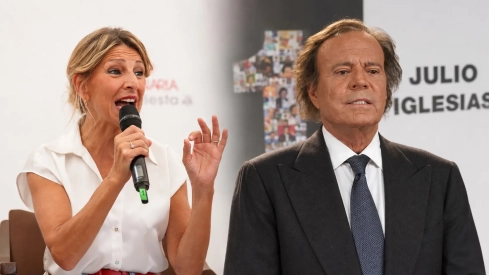
Julio Iglesias has suffered a first setback this Tuesday in the judicial offensive launched against Yolanda Díaz for her statements about the testimonies of two former employees of the singer. The Supreme Court has dismissed his lawsuit for lack of jurisdiction and has determined that the matter must be brought before the ordinary courts of Madrid.
The artist demanded from the second vice-president an indemnity of 50,000 euros, a public retraction and the payment of costs for an alleged interference with his right to honor and privacy. The lawsuit was directed against words spoken by Díaz on social media and in an interview on TVE after the accusations of the former employees became known.
The Civil Chamber rules out that those interventions were related to Díaz's functions within the Government. According to the order, the Sumar leader expressed herself "as a citizen and political leader" and acted essentially "as a feminist politician", apart from her responsibilities as Minister of Labor and Second Vice-President.
Díaz's parliamentary immunity does not cover her statements
The decision responds to the limits of the parliamentary immunity of government members. Article 56.2 of the Organic Law of the Judiciary reserves to the Supreme Court civil liability claims for acts committed "in the exercise of their office". The magistrates consider that this requirement is not met in this case.
The court differentiates between Díaz's responses related to her portfolio, such as those referring to the minimum wage, pensions or retirement, and her opinions about Julio Iglesias. The latter were part of her political and feminist discourse, without direct connection to the Ministry of Labor or the Vice-Presidency.
The order is limited to resolving which judicial body should examine the claim. The Supreme Court does not assess whether Díaz's words violated Iglesias's honor, nor does it rule on the accusations made by the two former employees. If the singer wants to maintain his lawsuit, he will have to file it again before a civil court in Madrid.
That court must weigh, if applicable, the right to honor claimed by Iglesias against Díaz's freedom of expression, the public interest of the information, and the singer's status as a public figure. It will also have to study the context in which the statements were made and whether the vice president presented as accredited facts accusations that remain pending judicial investigation.
Díaz had described as "chilling" the testimonies published by 'elDiario.es' and Univision and thanked the women and journalists who brought them to light. A day later, she stated on 'La hora de La 1' that the investigation produced "terror" and "panic" due to the situation of extreme vulnerability reported by the workers. When Iglesias demanded she retract, the vice president responded that "women do not shut up".
The singer's defense argued that these words conveyed an anticipated judgment of guilt to public opinion and violated his presumption of innocence. Iglesias has denied the accusations of his former employees, which he has described as "absolutely false", and assures that he has never abused, coerced, or disrespected any woman.
The complainants keep the criminal route open
The controversy has its origin in a journalistic investigation developed over three years. Two women who worked on Julio Iglesias' properties in the Dominican Republic and the Bahamas reported alleged sexual assaults, degrading working conditions, and a sustained environment of control and intimidation.
The Public Prosecutor's Office of the Audiencia Nacional archived the first complaint in January, considering that Spain lacked jurisdiction to investigate facts allegedly committed abroad. That archiving occurred due to a matter of competence and without examining the merits of the accusations.
The two women, accompanied by Women's Link, filed a new complaint directly with the Central Court of Instruction on September 3. They request an investigation into alleged crimes of human trafficking for forced labor and servitude, sexual violence, injuries, degrading treatment, and violation of workers' rights. The Audiencia Nacional still has to decide whether to admit the complaint.
Women's Link has also taken the case to six special United Nations mechanisms and has requested protection measures for the complainants, their families, and potential witnesses.
Julio Iglesias has extended his legal strategy to 'elDiario.es', its director, and four journalists who participated in the investigation. The lawsuit attributes crimes of libel, slander, and against moral integrity to them. The Madrid Press Association and FAPE have warned of its possible intimidating effect and have considered that the action threatens freedom of information. The Madrid court still has to decide whether to admit it.
Add ElConstitucional.es as a preferred Google source for free.
Stay informed about all the latest breaking news with the best information. Against disinformation, for democracy and social rights.
