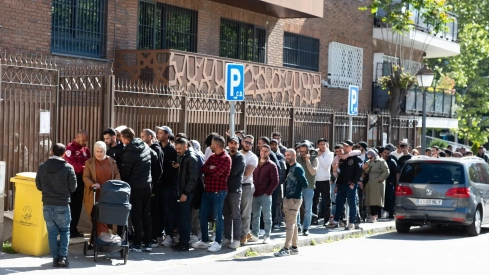
The Supreme Court has opened the door to taking the extraordinary migrant regularization decree before European justice. Through two orders issued by the Contentious-Administrative Chamber, the high court has informed the autonomous communities that appealed the measure, the Valencian Community and Aragon, that they have five days to comment on the possibility of raising a preliminary question before the Court of Justice of the European Union (CJEU).
This consultation arises from the "doubt" that this measure could "collide" with what the European Union's Pact on Migration and Asylum develops. The Chamber asks the parties whether it is admissible for people in an irregular situation in Spain to be excluded from a return order, beyond the exceptions contemplated by community regulations themselves, and, instead, obtain a general temporary residence right simply by being in that situation, all this despite the fact that Spain has not transposed the European Return Directive into its legal system.
The Supreme Court had already refused to stop regularization in the precautionary phase
In two orders from the Contentious-Administrative Chamber, the high court had previously responded to the appeals by Vox and the Community of Madrid against the royal decree on migrant regularization, in which the immediate suspension of the norm was requested. The request was dismissed by the Supreme Court, thus rejecting the precautionary measures.
On that occasion, the court already hinted at its decision not to paralyze the application of the decree while the merits of the case are resolved. The judges emphasized that in the questioned royal decree "there is an especially qualified public interest not only because it pursues a notorious public interest but because this public interest directly, intimately and qualifiedly affects a human substrate that transcends mere economic consideration."
