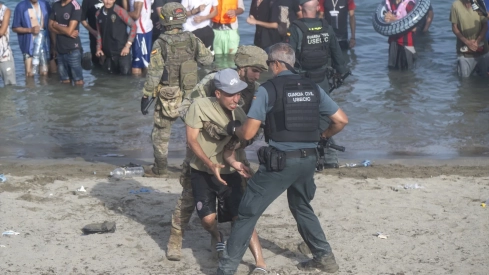
The ultra-conservative association Hazte Oír has turned the migratory crisis in Ceuta into its new judicial front against the Government. The organization has filed a complaint against alleged Moroccan intelligence agents, commanders of the Royal Gendarmerie and the Auxiliary Forces of Morocco, in addition to the Government delegate in the autonomous city, Miguel Ángel Pérez Triano.
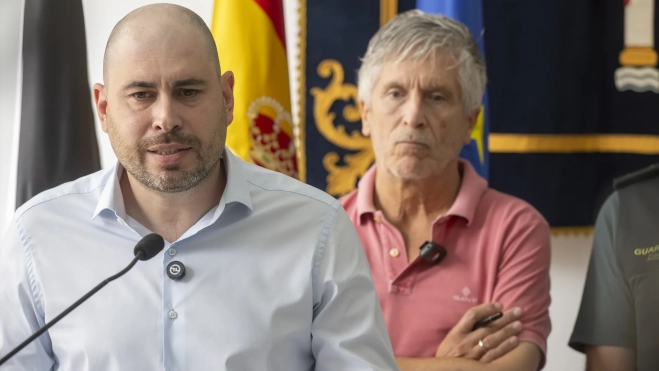
The brief seeks to be incorporated into the proceedings opened this Monday by National Court magistrate María Tardón after a complaint from Iustitia Europa. The judge has only requested a report from the General Commissariat of Immigration and Borders to verify if the massive entry could have been a concerted action and then decide if the court has jurisdiction to investigate it.
Hazte Oír has not yet been admitted as a popular prosecution and the magistrate has not assumed the accusations directed against specific individuals either. The organization presents Spanish and Moroccan authorities as responsible, who for now are not listed as investigated within these preliminary proceedings.
The complaint expressly names Fouad Ali El Himma, advisor and one of the people closest to King Mohammed VI, whom Hazte Oír places as the alleged person responsible for the operation based on "different information." No judicial resolution has so far attributed any participation to El Himma in the events recorded in Ceuta.
Accusations without judicial endorsement
The association divides responsibilities into four groups. It points to alleged Moroccan agents infiltrated in Ceuta, commanders of the neighboring country's border forces, possible organizers of the entry, and Spanish authorities who would have transmitted or executed an order to stop the intervention of security forces.
Hazte Oír asks to find out who gave the instruction to "be seen, but without intervening" and who would have sent the soldiers without ammunition or authorization to use force. The existence of these orders is part of the complainant's narrative and is not accredited in the proceedings opened by Tardón.
Among the material provided is the recording of a vehicle located next to Tarajal. The organization claims that its occupants helped certain people after crossing the border and avoided being filmed. Based on these images, it requests to identify them and verify if they had any relationship with the Moroccan services, although there is no official identification to support this suspicion.
The document lists possible crimes against the peace or independence of the State, aggravated facilitation of irregular immigration, criminal organization, prevarication, denial of assistance, homicide, and injuries due to serious negligence. This is the classification proposed by Hazte Oír and not crimes attributed by the court to the defendants.
The association also demands to preserve video surveillance recordings, police and military communications, operational orders, and contacts maintained with Morocco between July 27 and August 2. This request seeks to prevent some of that material from disappearing while the Audiencia Nacional decides whether to take on the investigation.
Another front for Hazte Oír
Hazte Oír arrives at the procedure with a long history of judicializing its ultracatholic agenda. The entity leads the popular prosecution against Begoña Gómez and has intervened in different cases affecting the Government, the PSOE, or Pedro Sánchez's circle, with requests for sentences much higher than those defended by the Prosecutor's Office.
This strategy has also received significant judicial setbacks. The investigating judge of the DANA case excluded the association after rejecting its complaints against the Government delegate in the Valencian Community and the president of the Júcar Hydrographic Confederation. In early 2026, the Audiencia Nacional dismissed another complaint against José Luis Rodríguez Zapatero for drug trafficking, money laundering, and criminal organization, considering that it lacked rational evidence and was based on journalistic information and conjectures.
The seriousness of what happened in Ceuta demands clarification of how an entry that overwhelmed the border and left dozens dead was organized. The report commissioned from Extranjería must now determine if there are elements pointing to a concerted action. With that document, María Tardón will decide if the Audiencia Nacional is competent and what course of action it grants to Hazte Oír's complaint.
Add ElConstitucional.es as a preferred Google source for free.
Stay informed about all the latest breaking news with the best information. Against disinformation, for democracy and social rights.
