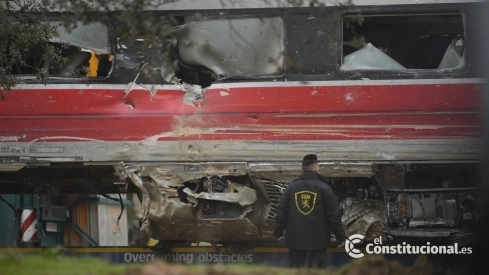
The Civil Guard agent Arturo Carmona, the first to arrive at the Alvia train involved in the railway accident in Adamuz, recounted that almost an hour after the crash there was no medical personnel or emergency teams with that train, and that the affected people were practically alone trying to organize themselves after the tragedy.
Carmona and his partner were initially dispatched to the scene of the incident after receiving news of an Iryo train derailment. Upon arrival, they confirmed that many people were walking injured and that neighbors and firefighters were already collaborating, but the magnitude of the impact was not yet clear to them.
While attending to the injured from the Iryo, **injured passengers walking through the darkness informed them that there was another crashed train**, the **Alvia**, which until that moment had not appeared in official reports. Carmona then walked towards that train, about **800 meters** away, where he encountered what he described as **"hell"**: scattered bodies, people trapped after having exited through the windows, and no medical services present in the initial moments
The agent recalls shocking scenes, such as a little girl who said her parents were dead, and highlights the initial confusion among emergency teams about the existence of two crashed trains. At times, even central services—such as the Atocha station itself—were unaware of the complete situation on the tracks in real-time. Agent Arturo Carmona had to directly inform Adif of the magnitude of the accident, as, in his words, "they didn't know." While helping the Alvia passengers as best he could, he received a call from the Atocha control center: "They called me from the control center and asked: 'Hey, what's happening there? Can you describe it to us, please?' They didn't know what it was like there at that moment," he recounts. Carmona did not hesitate to explain the gravity of the situation: an accident with multiple dead and injured, and insisted that the electricity in the area be cut off to prevent an even greater tragedy.
As he turned to observe the convoy, Carmona described what he saw as "terrible": bodies lying on both sides of the track and overturned carriages on the embankment. "Hands cannot pass through metal," he said, expressing the helplessness he felt upon realizing the magnitude of the catastrophe and the difficulty in reaching the victims. The scene shows the initial lack of coordination and the chaos that reigned in the first hour after the collision between the trains.
This testimony aligns with other analyses that indicate the arrival of the first medical personnel and agents to the Alvia train was delayed, partly due to a lack of precise information about the involvement of both trains in the accident, which left some victims without specialized assistance in the initial moments after the crash.
