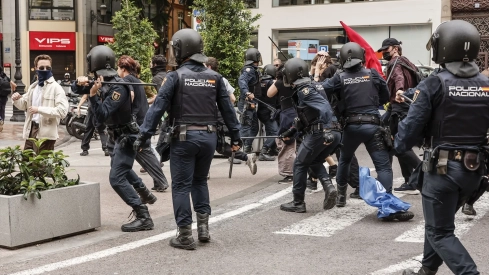
The Ministry of Interior confirmed this Friday that it has ordered the General Directorate of the National Police to modify the internal protocol for the use of tear gas to prohibit this police defense material, a decision that the department had already announced after the controversy generated by the police charges recorded during the 11N strike.
Sources from the ministry itself have indicated that, from now on, in public order operations, the National Police will be able to continue using ATL devices, canisters that develop a "harmless and non-injurious tear gas cloud," while other means habitually employed by riot police, such as rubber bullets or blank cartridge shotguns, continue to be part of their interventions to disperse a crowd.
Reserved information in Madrid for the 11N actions
The department headed by Fernando Grande-Marlaska also indicated that the Superior Headquarters of Madrid opened a reserved investigation this Thursday to evaluate the police actions carried out during the general strike day in the capital.
The decision to withdraw the use of tear gas against demonstrators has angered several National Police unions, who consider that the measure puts security forces agents "under suspicion." These organizations have even argued that the decision means "leaving agents sold out and defenseless," a criticism shared by the majority union among commanders and also the Unified Police Union (SUP), Jupol, the Federal Police Union (UFP), and the Spanish Police Confederation (CEP).
The previous instruction on violent pickets and barricades
The Interior Ministry also recalled that, before the strike, it ordered the National Police and the Civil Guard to have sufficient deployments to prevent "violent pickets" or barricades, and to guarantee security in critical infrastructures, industrial estates, central supply markets, or small commercial establishments, according to the instruction from the Secretary of State of October 6.
Marlaska rules out resigning and defends proportionality
This past Thursday, in statements to the press before attending an event of the PSOE in Madrid for the general elections, Fernando Grande-Marlaska ruled out resigning and questioned the proportionality of some police charges in interventions against pickets and demonstrators during the strike called by unions for access to housing and salary improvement.
Fernando Grande-Marlaska assured that he had ordered a "very specific investigation" apart from the protocolary analyses carried out by the Police in this type of public order operations, and added: "Yesterday there were some actions that, at first glance, are not pleasing and do not reconcile very well with the principles of proportionality."
Nevertheless, the minister defended "the legitimate exercise of public force by all Police and Civil Guard" and claimed that Spain has a Police in terms of citizen security that is "absolutely exemplary and worthy" and "a global benchmark," citing as examples the Ibero-American Summit, the NATO summit, and the UN financing summit.
Asked about his continuity in office, the Interior Minister replied that he did not believe he had "any reason" to resign, and defended that his work is based on maintaining a balance between "defending the actions of police officers and civil guards, but also defending that citizens can exercise their rights and freedoms with full guarantees."
"All actions and all means employed by the State Security Forces and Corps must be absolutely proportional and necessary to the actions they carry out and, of course, not be absolutely injurious to citizens," the minister reiterated.
Contact